OpenAI Sponsored Agents is moving advertising in ChatGPT beyond the traditional click. On September 16, 2026, the company announced that it is testing a new ad experience that lets a person who clicks an ad start a clearly labeled conversation with an AI agent sponsored by the advertiser. OpenAI is also expanding its advertising stack with AI-assisted campaign creation, new Ads Manager capabilities, a HubSpot CRM integration, and a Shopify e-commerce integration. The result is a potentially important shift from advertising as a message to Ai advertising as an interactive, agentic workflow.
What Happened
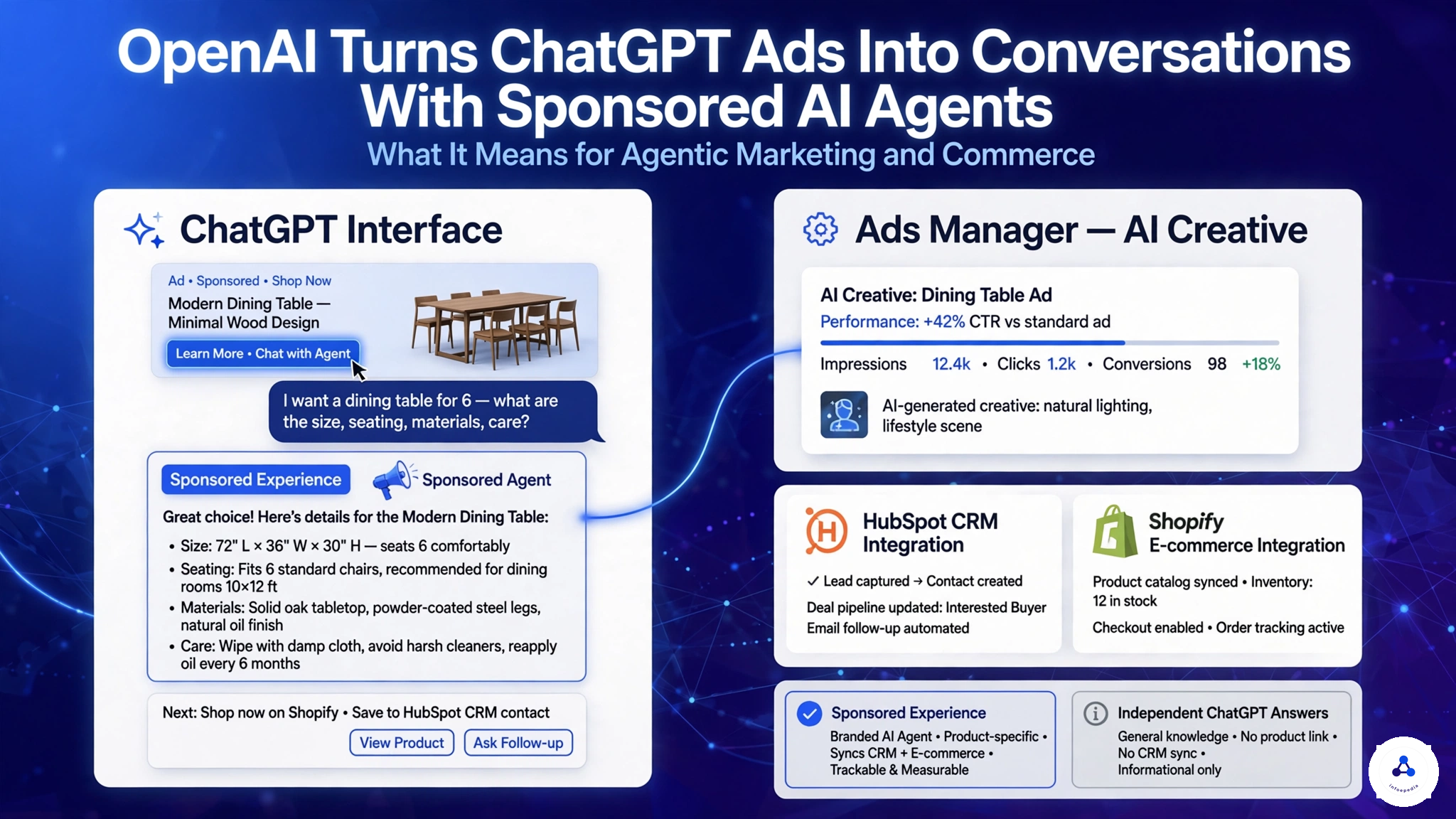
OpenAI says Sponsored Agents allow users to go deeper after seeing an ad. Instead of leaving ChatGPT Ads immediately, a user can choose to start a conversation with an advertiser-sponsored agent. OpenAI’s example is a shopper interested in a dining table who wants to ask practical questions about size, seating capacity, materials, or care. The sponsored experience is clearly labeled and is designed to remain separate from ChatGPT’s independent answers and the user’s original conversation.
The announcement also expands the tools available to advertisers. OpenAI says businesses can use natural-language prompts in ChatGPT Work to help create advertisements. Ads Manager is being upgraded with AI creative capabilities, including suggestions for copy and images based on an advertiser’s landing page and campaign objective. OpenAI also introduced optional AI text customization for adapting headlines and descriptions to conversational context and translating them into a user’s preferred language.
Two integrations make the shift especially relevant to businesses. HubSpot is OpenAI’s first named CRM partner for ChatGPT Ads, while Shopify is its first named e-commerce partner. This connects advertising activity to the systems where marketers manage leads, customer relationships, product catalogs, and commerce operations.
Why It Matters
The strategic significance is bigger than a new ad format. Search Ai advertising traditionally captures intent with a query and sends a person to a destination. Social advertising often captures attention and asks for a click. A conversational AI interface can compress discovery, consideration, qualification, and action into one continuous interaction.
That creates a new category of agentic marketing: the Ai advertiser is no longer only paying for exposure; it can potentially pay for an AI-mediated conversation that explains products, answers objections, qualifies the customer, and hands off to the business when the shopper is ready.
For agentic commerce, this is even more important. Product discovery is increasingly becoming a dialogue. A customer can ask for comparisons, constraints, compatibility, use cases, budget fit, and tradeoffs before taking action. A sponsored agent can occupy part of that decision journey.
Technical and Business Analysis
The underlying technical change is the separation of roles. ChatGPT Ads remains the general assistant, while the sponsored experience is a distinct business-controlled conversational layer. That separation is important for trust because users need to know when they are interacting with a commercial representative rather than the assistant operating independently.
For businesses, this creates a new interface layer between advertising, CRM, product data, and customer support. The quality of the agent will depend on far more than a language model. It will need accurate product information, pricing rules, inventory context, policies, brand voice, escalation logic, and secure access to business systems.
The HubSpot connection matters because agentic marketing is increasingly measurable at the lead and customer level, not just at the impression level. The Shopify connection matters because product catalogs are becoming machine-readable inputs for conversational commerce.
Agentic AI Implications
Sponsored Agents are a clear example of agents moving from answering questions to performing a business function. A agentic marketing can understand an intent, retrieve relevant product information, answer follow-up questions, and guide the user toward the next action.
The key architectural lesson is that the agent should operate inside a controlled workflow. Give it specific tools, scoped data, approved claims, and clear boundaries. Agent autonomy without governance can create brand, legal, and customer-experience risk.
Agentic Commerce Implications
Agentic commerce depends on accurate product data and low-friction decision support. Sponsored Agents could become part of a shopping funnel in which the consumer asks:
– Does this product fit my needs?
– What is the difference between these two models?
– Does it fit my budget?
– What accessories do I need?
– Can I return it?
– What happens after I buy?
The important distinction is that the agent can potentially handle the consideration layerrather than merely presenting an ad.
For Shopify merchants, this may be an early signal that product feeds, catalog quality, merchant policies, and structured data will become as important to AI commerce as they already are to traditional search and marketplaces.
Agentic Marketing Implications
Agentic Marketing will need to optimize for conversations, not only impressions and clicks. The new questions become: Can an agent explain our value proposition? Can it handle objections accurately? Can it distinguish us from competitors without making unsupported claims? Can it pass qualified intent into the CRM?
That also changes creative strategy. Brand content must become agent-readable. Product pages, FAQs, comparisons, proof points, reviews, and policy information should be written so both humans and AI systems can understand them.
Practical Business Takeaways
First, prepare your website and product catalog for AI-mediated discovery. Second, connect marketing, CRM, and commerce data so an agent can answer consistently. Third, define an approved knowledge base and prohibited claims. Fourth, create escalation rules for pricing, refunds, sensitive customer issues, and high-value sales. Fifth, measure the whole path from ad exposure to qualified conversation, checkout, revenue, and retention.
Future Outlook
Sponsored advertising is likely to evolve toward agentic demand generation. The unit of value may gradually move from the click to the qualified conversation, from the conversation to the recommendation, and from the recommendation to the transaction.
The biggest winners will not necessarily be the brands with the largest ad budgets. They may be the brands with the best product data, strongest trust signals, fastest fulfillment, and most useful AI experiences.
FAQ
What are OpenAI Sponsored Agents?
They are advertiser-sponsored conversational experiences that users can enter after clicking an ad in ChatGPT.
Are Sponsored Agents part of normal ChatGPT Ads answers?
OpenAI says the sponsored conversation is separately labeled and distinct from ChatGPT Ads independent responses.
How does this affect agentic marketing?
agentic marketing moves advertising from one-way exposure toward interactive AI-assisted product and service conversations.
How does this affect e-commerce?
A sponsored agent can potentially help shoppers understand products, resolve objections, and move toward a purchase.
Why are Shopify and HubSpot important?
They connect the advertising experience with product catalog and CRM workflows, making the system more operational rather than purely media-focused.
Conclusion
OpenAI’s Sponsored Agents are an early but important signal that advertising inside AI systems is becoming conversational and potentially agentic. The future agentic marketing funnel may be less about sending people from an ad to a page and more about letting an AI interface help customers evaluate, qualify, and act. For businesses, the strategic response is clear: build high-quality product data, trustworthy content, connected workflows, and AI-ready customer experiences before conversational advertising becomes mainstream.