OpenAI Agents API has released its Agents API in public beta, giving developers access to the Codex harness and managed infrastructure used to run long-lived AI agents. The September 10, 2026 launch is significant because it moves the center of gravity in agentic AI away from isolated chat sessions and toward software that can plan, call tools, coordinate subagents, work with files, execute code, and persist across days.
What happened
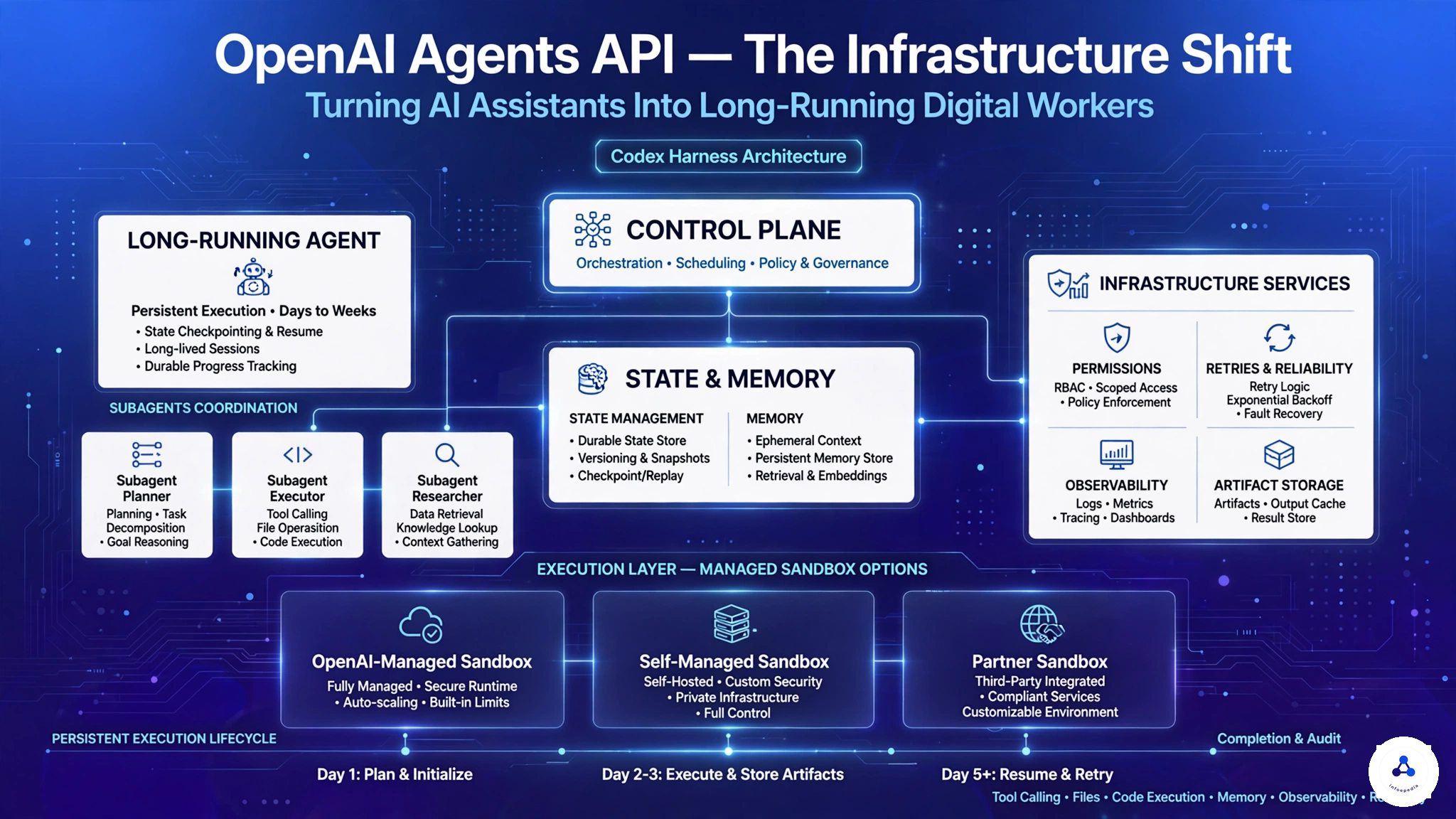
OpenAI Agents API says the Agents API packages the operational layer required for reliable agent execution. That layer manages context, tool use, subagent coordination, files, code execution, intermediate results, and long-running environments. Developers can choose an OpenAI-managed sandbox, their own infrastructure, or a partner sandbox, while OpenAI maintains the harness itself. The goal is to make it easier for product teams to deploy agents that do more than answer questions: they can complete multi-step workflows and return with results, exceptions, or requests for human judgment.
Why it matters
The biggest change is architectural. Many early AI applications treated the model as the product. In practice, dependable agents need an execution system around the model: state management, permissions, retries, observability, memory, artifact storage, and recovery. By exposing this infrastructure through an API, OpenAI is effectively productizing the control plane for agentic software.
Technical and business analysis
A long-running agent is closer to a distributed application than a chatbot. It must preserve context across steps, decide when to call tools, recover from partial failure, and avoid duplicating work. Subagents create parallelism, but they also introduce coordination and cost challenges. The most important business metric therefore becomes cost per completed task, not cost per prompt. Companies will also need evaluation suites that measure completion rate, intervention rate, latency, tool accuracy, and business impact.
Agentic AI implications
The Agents API lowers the barrier for building research agents, coding agents, operations agents, and customer-service agents. It also accelerates a shift from single-agent design to multi-agent orchestration. One agent may decompose the work, others may search data or execute code, and a final agent may validate the result. That pattern can increase throughput, but it makes identity, authorization, and audit trails essential.
Agentic Commerce implications
In agentic commerce, a persistent agent could monitor inventory, compare suppliers, update product feeds, coordinate fulfillment exceptions, and prepare purchase recommendations. An agent may discover a product, verify policies, negotiate a business rule, and route the final decision to a human. This enables commerce systems that act continuously instead of waiting for a customer to ask a question.
Agentic Marketing implications
Marketing teams can use long-running agents to monitor campaigns, identify anomalies, generate test briefs, refresh audience segments, and coordinate creative production. The winning architecture will connect agents to approved data sources, CRM systems, analytics, and publishing tools while preserving brand and compliance controls.
Practical business takeaways
Start with one workflow that has clear inputs, outputs, and approval points. Define the agent’s permissions before selecting a model. Log every tool call. Set budgets for time, tokens, and external actions. Build a rollback path. Measure business outcomes such as cycle time, conversion rate, revenue per workflow, and human intervention.
Future outlook
The next phase of agentic software will be shaped less by model demos and more by infrastructure quality. OpenAI’s move suggests that managed agent runtimes will become a competitive layer alongside models and cloud services. Expect more ecosystems around sandboxing, observability, identity, and agent-to-agent communication.
FAQ
What is OpenAI’s Agents API? It is a public-beta API for building and running long-lived cloud agents using the Codex execution harness.
Why is the harness important? It manages context, tools, files, code, subagents, and durable execution.
Can businesses use their own infrastructure? OpenAI says developers can choose OpenAI-managed, self-managed, or partner sandboxes.
What should companies measure? Completion, cost per task, latency, reliability, safety, and human intervention.
Conclusion
The Agents API is a signal that agentic AI is becoming an infrastructure discipline. The next winners will not simply ask which model is smartest. They will build systems that let agents act safely, persist reliably, and create measurable business value.