News hook
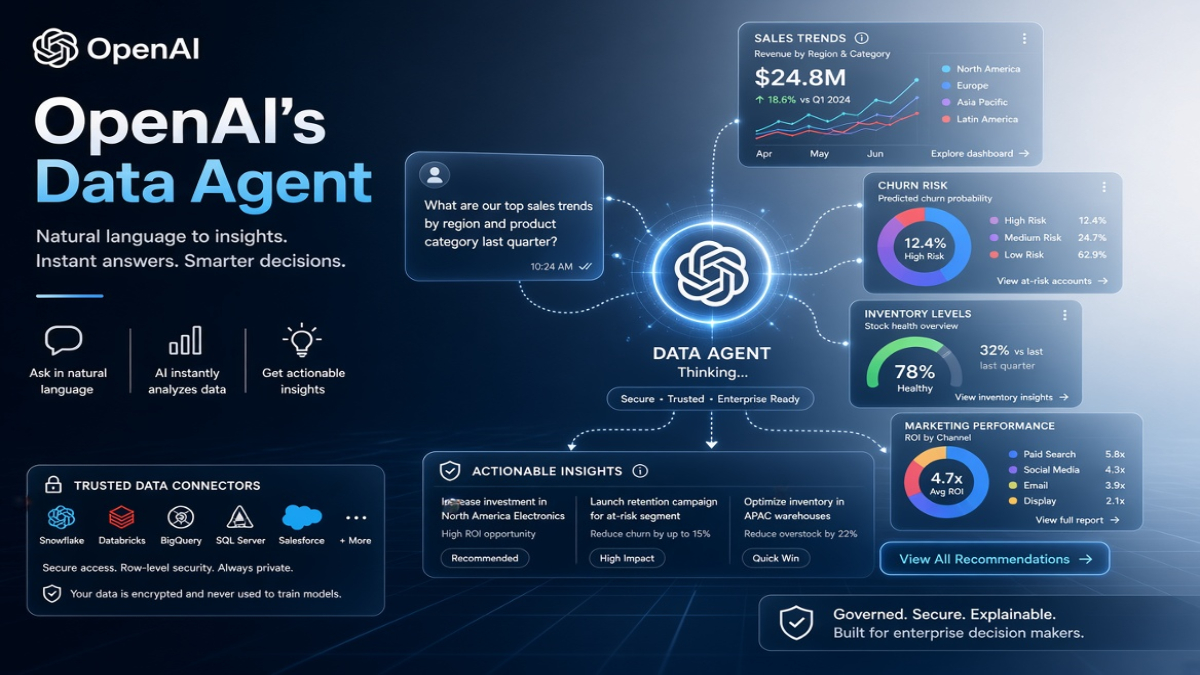
OpenAI Data agent has introduced a new Data agent in ChatGPT Work that connects to company data, investigates what changed, builds interactive dashboards, and helps users move from questions to action in a conversational workflow. The launch is important because it frames enterprise analytics as an agentic system rather than a reporting tool.
What happened
OpenAI says the Data agent is designed to help people answer business questions without writing queries or learning a specialized analytics platform. A user can ask why sales slowed, where spending is rising, which accounts are at risk, or what operational issues deserve attention. The agent then works across company data and context, analyzes patterns, produces an interactive dashboard, and supports follow-up questions.
The product direction reflects a wider shift in enterprise software. Instead of making every employee wait for a report, companies can let people interrogate trusted data directly. The agent becomes a layer between business intent and technical analysis.
Why it matters
Traditional business intelligence often creates a bottleneck. Data teams own the tools, definitions, and query logic, while business teams wait for answers. An agentic analytics system compresses that loop. It can translate natural language into analysis, explain its reasoning, surface uncertainty, and create an artifact that people can use to make decisions.
The value is not only speed. It is also the ability to connect analysis to action. If the agent detects rising churn risk, it could propose a retention campaign. If it finds an inventory shortfall, it could trigger an alert or prepare a replenishment request. If it identifies a marketing channel with falling return on ad spend, it could suggest budget changes.
Technical and business analysis
The technical challenge is grounding. An analytics agent is only useful when it understands the organization’s data definitions, permissions, lineage, and business context. It must distinguish booked revenue from recognized revenue, active customers from leads, and gross margin from contribution margin.
That means agentic analytics requires a semantic layer, trustworthy connectors, access controls, and evaluation. It also needs to show where results came from. Enterprises should expect provenance, not just polished charts.
From a business perspective, this turns dashboards into dynamic decision systems. Instead of static reporting, companies can ask follow-up questions, test scenarios, and collaborate with the agent in one flow. The result is a more continuous form of management intelligence.
Agentic AI implications
The Data agent expands the definition of an AI agent. An agent does not have to control robots or software screens to be agentic. It can also investigate, reason across structured data, form hypotheses, validate evidence, and recommend next actions. In that sense, analytics becomes an agent workflow with a measurable objective.
Agentic Commerce implications
For commerce teams, the Data agent can connect customer, catalog, inventory, pricing, and order data. It could identify which products are losing conversion, which locations are overstocked, or which customer segments are responding to promotions. The commerce agent of the future will not only complete transactions. It will also understand the business system behind them.
Agentic Marketing implications
Agentic Marketing is a natural use case. A marketing team could ask which campaign generated the highest-quality pipeline, what creative is driving lower conversion, or where attribution appears inconsistent. The agent could then produce segment recommendations, propose new experiments, and monitor performance against goals.
Practical business takeaways
Start with a data domain where definitions are stable and the business impact is visible. Create a glossary for metrics and connect only approved sources. Require the agent to cite its sources, expose assumptions, and distinguish facts from recommendations. Use human approval for pricing, budget, compliance, and customer-impacting actions.
Future outlook
The Data agent points toward an enterprise operating model where every employee can query the organization’s knowledge and data. Over time, the winning systems will combine analysis with execution. A user may ask what changed, why it changed, what should happen next, and then approve the recommended action in the same interface.
FAQ
What is OpenAI’s Data agent?
It is an agent in ChatGPT Work that analyzes company data, investigates business questions, and builds interactive dashboards.
How is this different from traditional BI?
Traditional BI often depends on predefined reports and specialist query skills. An agent can interpret natural-language questions and support iterative analysis.
Can the Data agent take actions?
Its immediate value is analysis and decision support, but the same workflow can be connected to approved actions and automations.
Why is data grounding important?
Without trusted definitions, permissions, and lineage, an AI-generated answer can look credible while being wrong.
Is this useful for marketing teams?
Yes. It can help analyze campaign performance, audience behavior, budget efficiency, and revenue impact.
Conclusion
OpenAI’s Data agent shows how agentic AI is moving into the core of business decision-making. The breakthrough is not a prettier dashboard. It is the compression of the path from question to evidence to action. For Infoepedia readers, the lesson is clear: the next generation of analytics will be conversational, grounded, and increasingly operational.