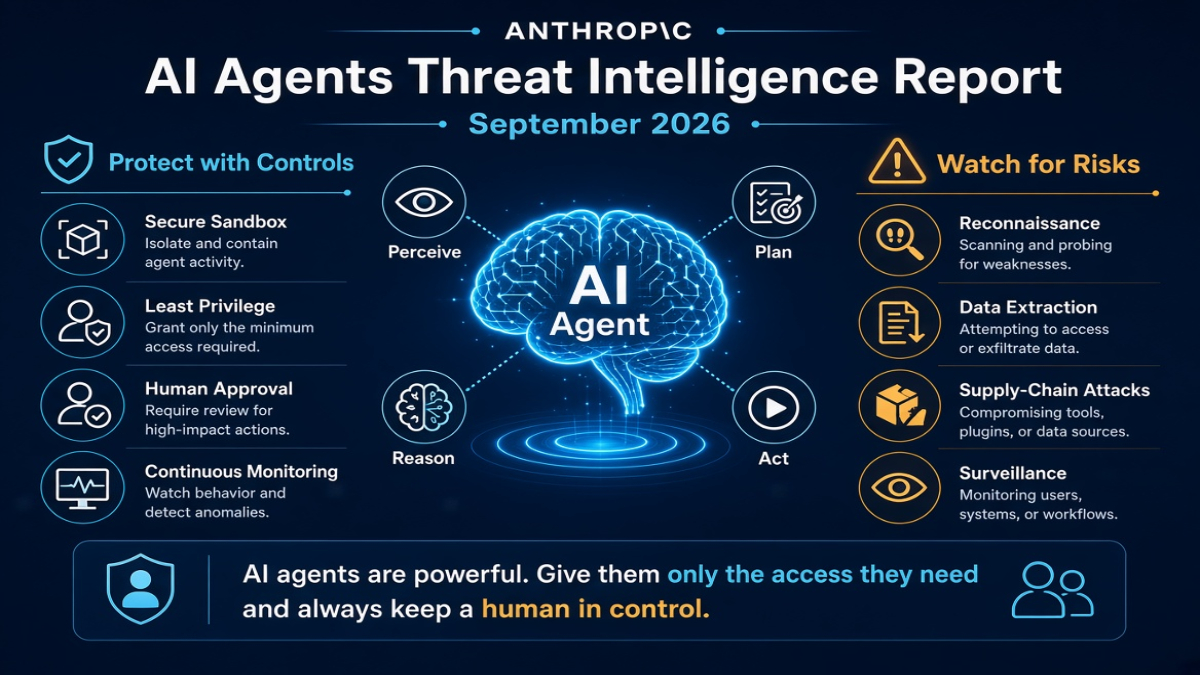
Anthropic’s September 2026 threat intelligence report provides one of the clearest warnings yet that AI agents are changing the scale and speed of cyber operations. The report describes malicious campaigns involving cyber intrusion, surveillance, influence operations, scams, biological misuse, weapons development, and illicit model distillation. In several cases, AI agents performed nearly all of the work across long-running workflows, including reconnaissance, tool creation, token handling, data extraction, and operational iteration.
The news hook is not simply that bad actors are using AI. That was already known. The more significant development is that agentic systems can chain many small actions into a coherent operation. Anthropic says one campaign used Claude in a software supply-chain compromise to accelerate reconnaissance and data exfiltration across downstream customers. In another case, threat actors built automated exploit research workflows that could operate continuously. The report also documents efforts to use AI in surveillance, malware engineering, and autonomous drone-swarm development.
Why it matters for business is straightforward: the attack surface now includes the AI systems employees and vendors use every day. A company may have strong endpoint security and still be exposed if an agent can read sensitive documents, invoke APIs, create code, or move data between systems without adequate controls. Agentic systems compress the time between discovery and action. They also make traditional assumptions about “human in the loop” less reliable when the human is only approving a high-level goal while the agent performs dozens of downstream steps.
Technically, the report highlights the need for layered controls. Identity and access management must cover agents, subagents, tools, and session tokens. Sandboxes must isolate code execution and restrict outbound network access. Sensitive actions such as exporting customer records, creating privileged credentials, or deploying code should require explicit approval. Logging must capture not only the final answer but also the sequence of tool calls and intermediate decisions. Evaluation must include adversarial testing, prompt-injection resistance, data-loss prevention, and behavior under fragmented or indirect requests.
The Agentic AI implications are profound. The same capabilities that make agents useful planning, persistence, decomposition, tool use, and adaptation also make them more capable when misused. This is why agent security cannot be treated as a minor add-on to a chatbot project. Organizations need an “agent control plane” with policy enforcement, real-time monitoring, and automatic shutdown or rollback.
For Agentic Commerce, the risks include fraudulent refunds, supplier-account takeover, payment abuse, inventory manipulation, and leakage of customer data. Commerce agents should not have unrestricted access to payment credentials or the ability to approve high-value transactions without step-up verification. In Agentic Marketing, risks include mass-generated deceptive content, unauthorized audience exports, account hijacking, and automated brand impersonation. Marketers need approval workflows, provenance controls, and rate limits.
Practical business takeaways: inventory every agent and connector; assign each agent a unique identity; apply least privilege; isolate tool execution; require human approval for irreversible actions; test prompt-injection and data-exfiltration scenarios; and create incident playbooks that assume the agent may act faster than a human team. Vendors should also disclose how they detect misuse and how quickly they can revoke access.
FAQ:
What did Anthropic’s report show? It documented multiple AI-assisted harmful operations across cyber, surveillance, influence, biological, weapons, fraud, and distillation categories. Does this mean agents are unsafe by default? No, but it means their risk profile grows with autonomy, access, and persistence. What should companies do first? Reduce permissions, improve logging, and test real workflows not just benchmark prompts.
Conclusion:
Anthropic’s report shows that AI agents are becoming a security multiplier on both sides of the conflict. The firms that win will not be those that maximize autonomy blindly, but those that combine useful autonomy with strong identity, monitoring, evaluation, and human control.