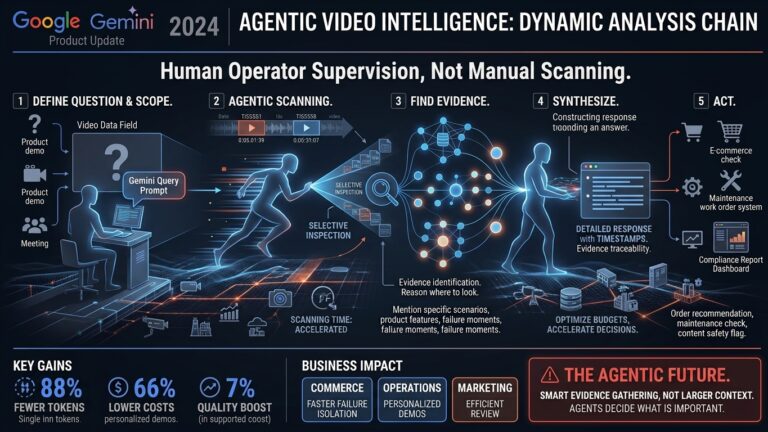
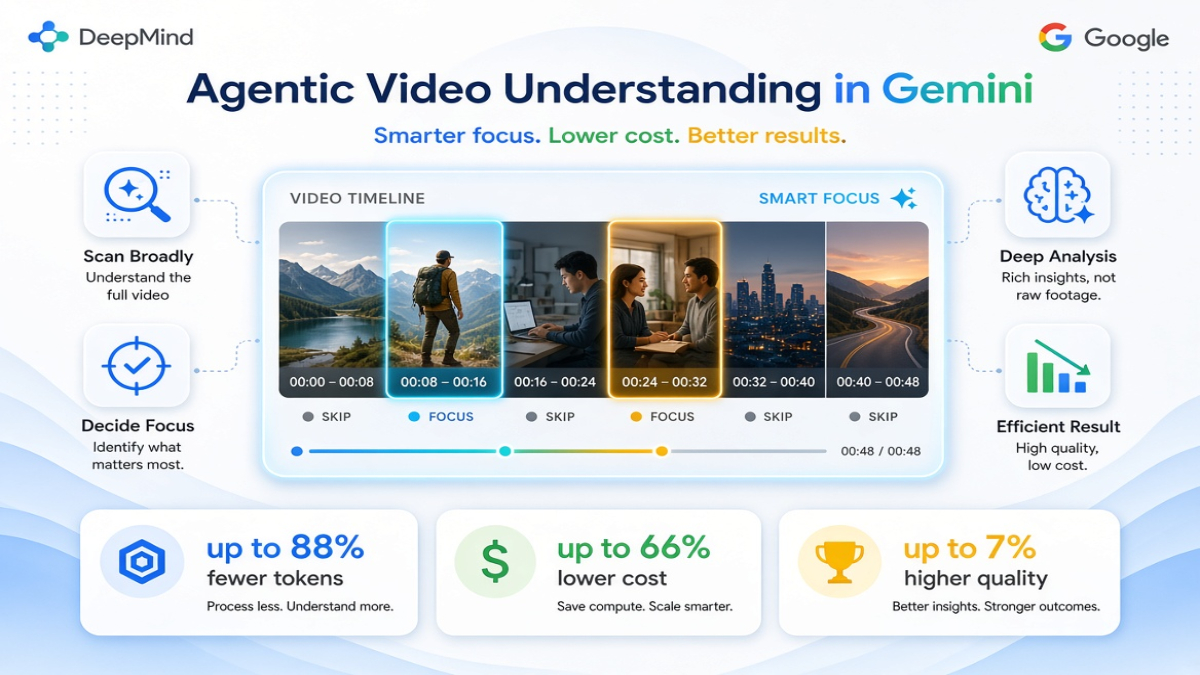
Google has introduced agentic video understanding in Gemini, a new capability that dynamically decides which parts of a video deserve closer analysis. According to Google DeepMind, the feature can cut token consumption by up to 88%, reduce costs by up to 66%, and improve quality by up to 7% in supported scenarios. The release, announced September 1, 2026, is available across Gemini 3.7 Flash, Gemini 3.6 Flash, and Gemini 3.5 Flash-Lite through Google AI Studio and the Gemini Enterprise Agent Platform.
The news hook is that Gemini video AI is becoming selective rather than exhaustive. Instead of processing every frame or segment with the same level of attention, an agent can scan broadly, identify moments that matter, and then spend more compute on those moments. This is a classic agentic pattern: observe, decide where to focus, use tools or deeper reasoning, and return a result. The innovation is not only better video understanding. It is a more efficient inference strategy for a data type that has historically been expensive to analyze at scale.
Why it matters for business is that video now sits inside nearly every customer journey. Retailers use product video, brands run short-form campaigns, marketplaces depend on visual merchandising, and support teams receive screen recordings and live-session clips. If organizations can analyze video more cheaply, they can automate workflows that were previously too expensive or too slow. Examples include extracting product attributes, identifying customer-service moments, detecting compliance issues, summarizing webinars, and turning long recordings into structured knowledge.
Technically, agentic video understanding suggests a two-stage architecture. The system first performs low-cost temporal scanning and creates candidate segments. It then allocates more detailed analysis to the segments most likely to contain relevant information. That approach improves efficiency because not every second of video deserves equal compute. For enterprise developers, the key advantage is controllable cost. They can process large video libraries while reserving deep reasoning for moments tied to a specific question or business event.
The Agentic AI implications are broad. Video becomes an input to planning and action, not just a source of captions. An agent could watch a product demo, extract claims, compare them with a catalog, flag unsupported statements, and route the content for review. It could analyze a customer call recording, identify a risk signal, update a CRM record, and assign a follow-up task. The agent can also combine video with documents, images, and structured data in a multimodal workflow.
In Agentic Commerce, this enables product-page enrichment, automatic quality checks, visual search, merchandising intelligence, and post-purchase support. An agent could watch an unboxing video to identify damage, compare the item with the order record, and initiate a replacement workflow subject to policy. In Agentic Marketing, the use cases include creative QA, brand-safety review, ad-variant analysis, influencer-content classification, and automated generation of campaign summaries.
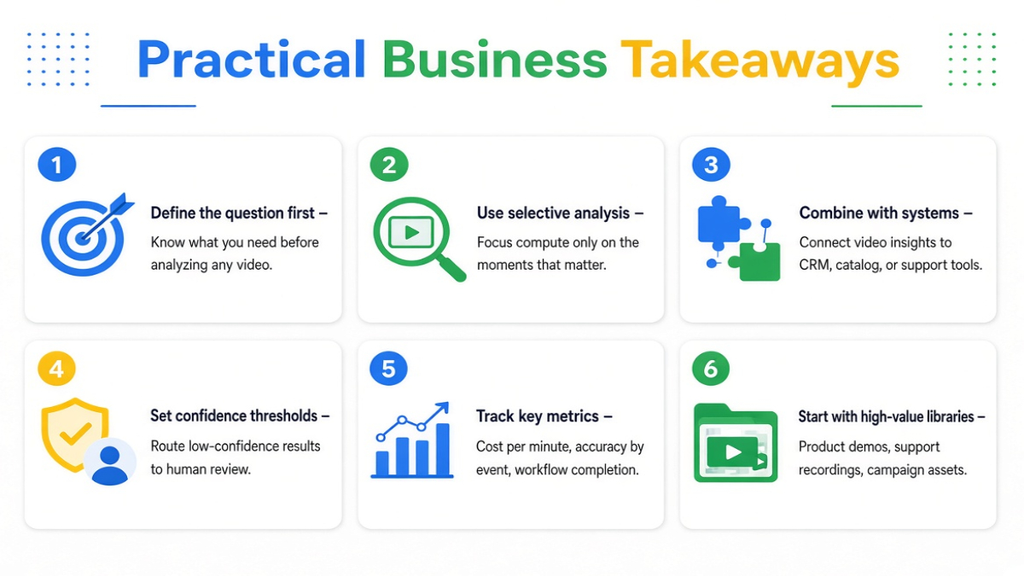
Practical business takeaways: define the business question before processing the video; use selective analysis to control cost; combine video outputs with structured systems; create confidence thresholds and human review paths; and track cost per processed minute, accuracy by event type, and downstream workflow completion. Start with high-value libraries such as product demos, support recordings, or campaign assets.
FAQ:
What is agentic video understanding? It is a system that dynamically selects which agentic video understanding segments to inspect in depth. How much cheaper is it? Google reports up to 66% lower cost and up to 88% lower token use in supported scenarios. Is it useful only for media companies? No; retail, support, marketing, manufacturing, education, and operations can all benefit.
Conclusion:
Google’s release turns video analysis into a more practical building block for enterprise agents. As multimodal systems become more selective and cost-aware, businesses can move from “AI can watch video” to “AI can watch the right moments and trigger the next action.”