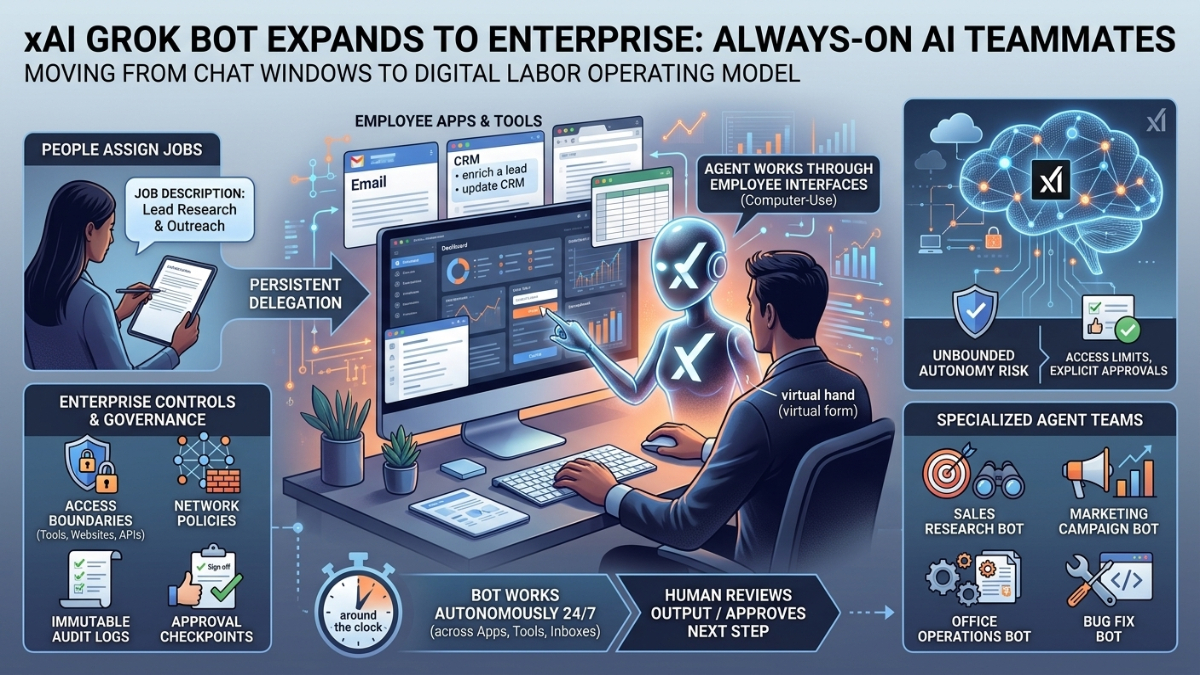
Grok Bot for Enterprise: xAI’s autonomous AI teammate., positioning the product as a team of always-on AI teammates that can work inside the same tools and apps employees already use. The company’s September 3, 2026 announcement says enterprise customers can create multiple Bots, give them real tasks, and let them work autonomously around the clock until the job is complete or a human decision is required. The news hook is that xAI is selling an operating model for digital labor, not just a smarter chat window.
What happened is that Grok Bot for Enterprise added access, network, and audit controls designed for organizational deployment. Each Bot runs on its own computer in the cloud and can interact with websites, apps, inboxes, and other tools in a way that resembles a human employee. xAI describes use cases across sales outreach, marketing campaigns, office operations, and bug fixes. The model is persistent delegation: people assign a job, the Bot continues working, and the human returns to review the output or approve the next step.
Why it matters is that many AI projects stop at recommendation. Enterprise value often appears only when a system can execute. Sales research is more useful when an agent can enrich a lead, prepare a message, update the CRM, and schedule a follow-up. Marketing analysis is more useful when an agent can monitor campaign performance, identify anomalies, draft changes, and route them for approval. Operations automation is more useful when it can coordinate multiple systems without forcing employees to copy and paste between tools.
Technically, Grok Bot illustrates the rise of computer-use agents. Rather than relying only on clean APIs, the Bot can operate through the same interfaces that employees use. That improves reach across legacy and fragmented systems, but it also raises risk. Computer-use agents can click the wrong button, misread a page, or act on a malicious instruction. Enterprise controls therefore matter as much as model capability. Access boundaries, network policies, audit logs, and approval checkpoints are necessary to keep autonomy within a defined operating envelope.
For Agentic AI, the key implication is that organizations may start managing collections of specialized agents rather than one universal assistant. One Bot can handle outbound research, another can monitor campaign performance, and another can triage internal requests. This specialization mirrors how teams work. It also creates a new management problem: companies need agent identity, ownership, performance metrics, escalation rules, and retirement policies.
Agentic Commerce opportunities are substantial. A Grok Bot could assist with supplier discovery, inventory checks, customer service, order tracking, returns, and marketplace operations. It might compare listings, monitor competitor prices, flag stock issues, or prepare product uploads across channels. But commerce agents should not be given unrestricted checkout or refund powers. Payment and customer-data actions need step-up authorization, fraud checks, and immutable logging.
In Agentic Marketing, xAI’s approach could support campaign monitoring, social listening, content briefs, creative testing, and CRM workflows. The agent can move from insight to action faster than a reporting dashboard, but brands should keep humans in the loop for claims, regulated content, and public publishing. A wrong automated change can create reputational and financial damage at scale.
Practical business takeaways: define a job description for each Bot, limit the apps it can access, make approvals explicit, start with reversible tasks, and evaluate performance against a baseline human process. Track task completion, rework, errors, and intervention rate. Treat agents as production software with change management, not as informal assistants.
The future outlook is that persistent AI teammates will become a major design pattern for enterprise software. The differentiator will be whether these agents can work across real systems while remaining observable and controllable.
FAQ:
What is Grok Bot for Enterprise? It is xAI’s enterprise deployment of persistent AI agents that can work across apps and websites. Why use multiple Bots? Specialization improves clarity, permissions, and measurement. What is the biggest risk? Unbounded computer-use autonomy. How should businesses start? Choose narrow, reversible workflows and add approvals before expanding.
Conclusion:
Grok Bot for Enterprise shows how AI is moving from answering questions to owning tasks. The companies that benefit most will be the ones that combine delegation with disciplined governance.