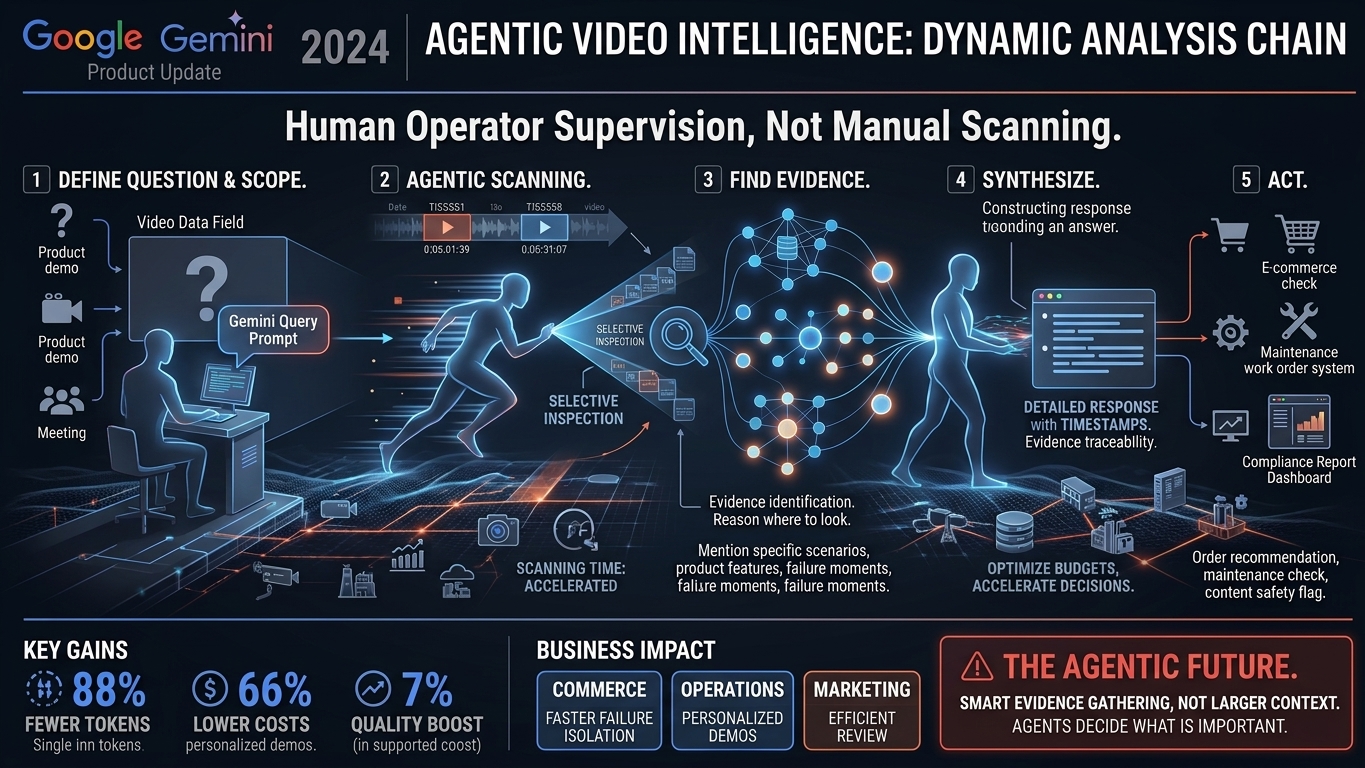
Google Gemini has introduced agentic video understanding in Gemini, a new capability that lets the model dynamically scan only the parts of a video that matter for a given question. Google says the feature can reduce token consumption by up to 88%, lower costs by up to 66%, and improve quality by up to 7% in supported scenarios. The announcement is important because it tackles one of the biggest practical barriers to multimodal AI: the cost and inefficiency of processing long video streams.
The news hook is that Gemini is moving from passive video summarization toward active visual investigation. Instead of treating every frame equally, the system can reason about where to look, inspect relevant segments, and refine its answer. That is an agentic pattern. The model is not merely generating text from a fixed input; it is deciding how to gather evidence from a large media source.
What happened is that Google made the feature available for Gemini 3.7 Flash, Gemini 3.6 Flash, and Gemini 3.5 Flash-Lite through Google AI Studio and the Gemini Enterprise Agent Platform. Developers can enable an “agentic” configuration so the model dynamically navigates video content. Google’s reported gains up to 88% fewer tokens and up to 66% lower cost suggest that intelligent retrieval can materially change the economics of multimodal applications.
Why it matters for business is straightforward. Video is everywhere: product demonstrations, training, support calls, retail footage, livestreams, webinars, factory operations, and social content. Traditional approaches often require exhaustive transcription, dense frame sampling, or expensive storage and inference. If an AI system can selectively inspect relevant moments, organizations may be able to process much more content with the same budget.
Technically, agentic video understanding is a form of adaptive attention and tool use. The system decides which timestamps or segments to inspect, gathers evidence, and then synthesizes the result. That can improve both efficiency and answer quality, especially when the relevant information appears only briefly. It also makes evaluation more complex. A system may save tokens while missing a critical event, so quality metrics must include recall, temporal grounding, and evidence traceability.
For Agentic AI, this is a meaningful expansion of the action space. Agents can now use video as an environment, not just as an input. An operations agent could review a machine-maintenance recording, isolate the moment of failure, and create a work order. A customer-support agent could inspect a screen recording, identify the step where a user got stuck, and recommend a fix. A compliance agent could sample surveillance or training footage and flag events for human review.
Agentic Commerce implications are especially strong. Retailers can deploy agents that understand product videos, livestreams, unboxing content, and customer-uploaded clips. A shopping agent could answer questions such as whether a jacket appears waterproof in a demonstration, whether a product includes a specific accessory, or which timestamp shows the relevant feature. Merchants could also analyze creator content at scale to extract product claims, compare demonstrations, and identify compliance risks.
In Agentic Marketing, video intelligence can support creative analysis, brand-safety review, competitor monitoring, and campaign optimization. An agent could inspect thousands of short videos, find the moments that drive engagement, classify hooks, and connect creative patterns with conversion outcomes. That enables faster testing and more precise content strategy.
Practical business takeaways: begin with a narrow video workflow, retain timestamps and evidence snippets, test recall on edge cases, and calculate total cost per analyzed hour. Use human review for safety, legal, or brand-sensitive decisions. Do not assume token savings automatically equal business value; measure whether the system improves outcomes.
The future outlook is that multimodal agents will increasingly decide what to observe, what to ignore, and when to ask for another view. That makes video understanding a building block for autonomous operations across media, retail, and enterprise workflows.
FAQ:
What is agentic video understanding? It is a Gemini feature that dynamically scans relevant video segments instead of processing everything uniformly. Why is it cheaper? Because the system selectively inspects content. Is it useful for commerce? Yes, for product demos, livestreams, returns, and customer support. How should companies evaluate it? Measure cost, recall, temporal accuracy, and human-review burden.
Conclusion:
Google’s Gemini update shows that the future of multimodal AI is not just larger context. It is smarter evidence gathering. By deciding where to look, agents can make video intelligence faster, cheaper, and more useful.