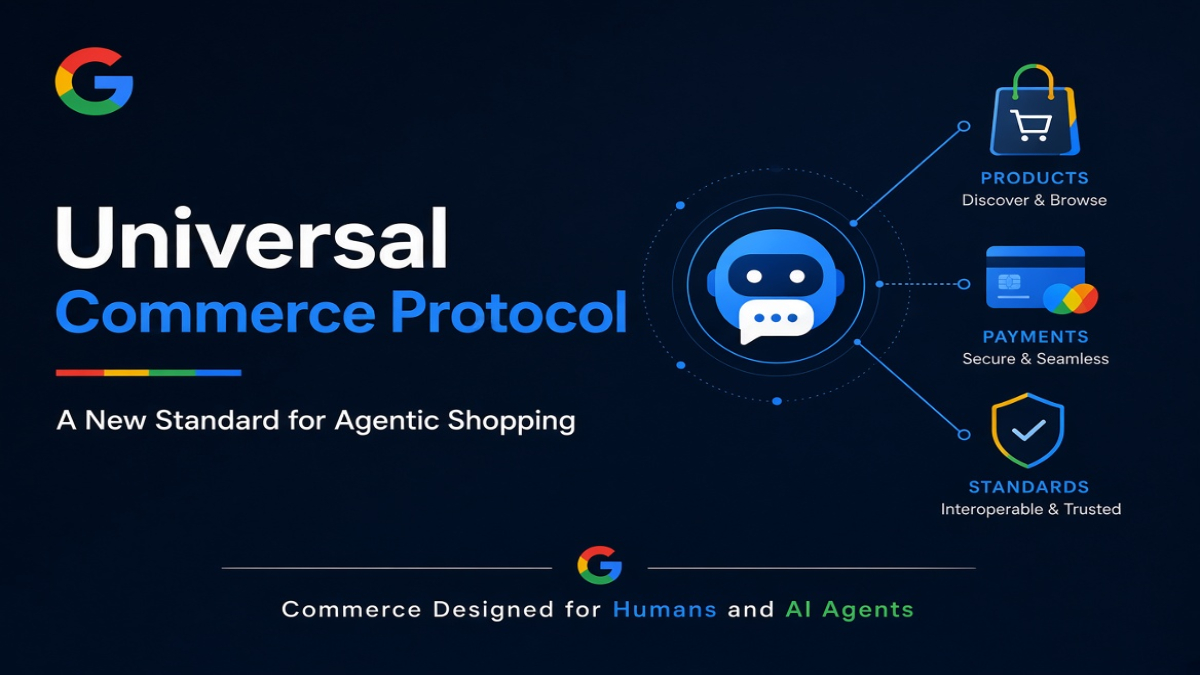
The infrastructure behind ecommerce is beginning to change as AI agents become participants in shopping. At the September 8–9, 2026 W3C and GS1 workshop on “E-commerce for humans and AI agents,” Google presented the Universal Commerce Protocol, or UCP, as an open-source approach for standardizing commerce interactions across businesses, platforms, and payment providers. The development is important because agentic commerce cannot scale if every AI agent must learn a different interface for every merchant.
Traditional ecommerce was designed primarily for humans. People browse product pages, click filters, read reviews, add products to carts, enter payment information, and complete checkout. AI agents operate differently. They need structured access to product information, availability, prices, policies, authentication, payment flows, and order status. Standard protocols can give agents a common language for these interactions.
The W3C and GS1 workshop illustrates how quickly this issue is becoming a standards problem. The event brings together web and commerce stakeholders to discuss how online content and data should work for both humans and AI agents. Sessions cover the Universal Commerce Protocol, physical-world context, payment flows, authorization, observability, auditability, human oversight, and merchant perspectives.
Why does this matter for businesses? Because agentic commerce changes who the “customer interface” is. A consumer may tell an AI assistant, “Find me the best laptop under $1,500 with strong battery life and delivery this week.” The agent could compare products, evaluate reviews and policies, verify availability, and potentially complete the transaction. The merchant’s website may become less important as a destination and more important as a source of trustworthy machine-readable information and transactional capabilities.
This creates a new optimization discipline. Ecommerce brands will need product information that is accurate, complete, current, structured, and consistent. Product identifiers, specifications, inventory, pricing, shipping, returns, warranties, seller identity, reviews, and payment options can all influence an agent’s decision. A page that looks beautiful to humans but exposes poor or inconsistent data may perform badly in an agent-mediated marketplace.
Agentic Commerce also connects directly to Agentic Marketing. If an AI agent chooses products rather than a person clicking an advertisement, marketing influence shifts toward relevance, trust, data quality, and measurable outcomes. Traditional paid acquisition will not disappear, but the path from marketing exposure to purchase could become increasingly mediated by AI systems.
There are important technical requirements as well. Agents need authorization boundaries, secure identity, audit logs, observability, and reliable payment flows. Standards such as UCP can help reduce fragmentation, but merchants still need strong internal infrastructure. A standardized protocol does not automatically make a company’s catalog accurate or its inventory reliable.
The business opportunity is large. Smaller merchants could theoretically become more discoverable if agents can compare products fairly across standardized interfaces. At the same time, marketplaces may retain advantages because they aggregate extensive catalogs, reviews, seller information, fulfillment, and payment capabilities. The outcome will depend heavily on how standards are adopted and how AI systems rank trust.
Practical takeaways: make product catalogs machine-readable, maintain consistent product identifiers, expose current pricing and inventory, document shipping and return policies clearly, prepare secure APIs or protocol integrations, and create approval and audit mechanisms for agent transactions.
For ecommerce agencies, this creates a new service category: Agentic Commerce Readiness. Agencies can audit product feeds, structured data, catalog quality, entity consistency, checkout infrastructure, payment permissions, and AI discoverability.
The future outlook is an internet where websites are designed for both humans and machines. The next generation of ecommerce standards may determine whether agentic shopping becomes fragmented and platform-dependent or interoperable and competitive. As the digital landscape continues to evolve, platforms such as Infoepedia can provide readers with additional insights into technology and emerging digital trends.
FAQ:
What is UCP? It is an open-source protocol presented by Google to standardize commerce interactions across businesses, platforms, and payment providers.
Why is it important? It can reduce the integration complexity of AI-driven commerce.
What should merchants do now? Improve structured product data, policies, inventory accuracy, APIs, and transaction security.
Will humans stop shopping directly? No; agents are likely to complement human shopping, especially for comparison-heavy purchases.
Conclusion: Agentic commerce requires a new digital foundation. As standards such as UCP develop, the brands that win may be those whose products are easiest for both humans and AI agents to understand, trust, compare, and buy.