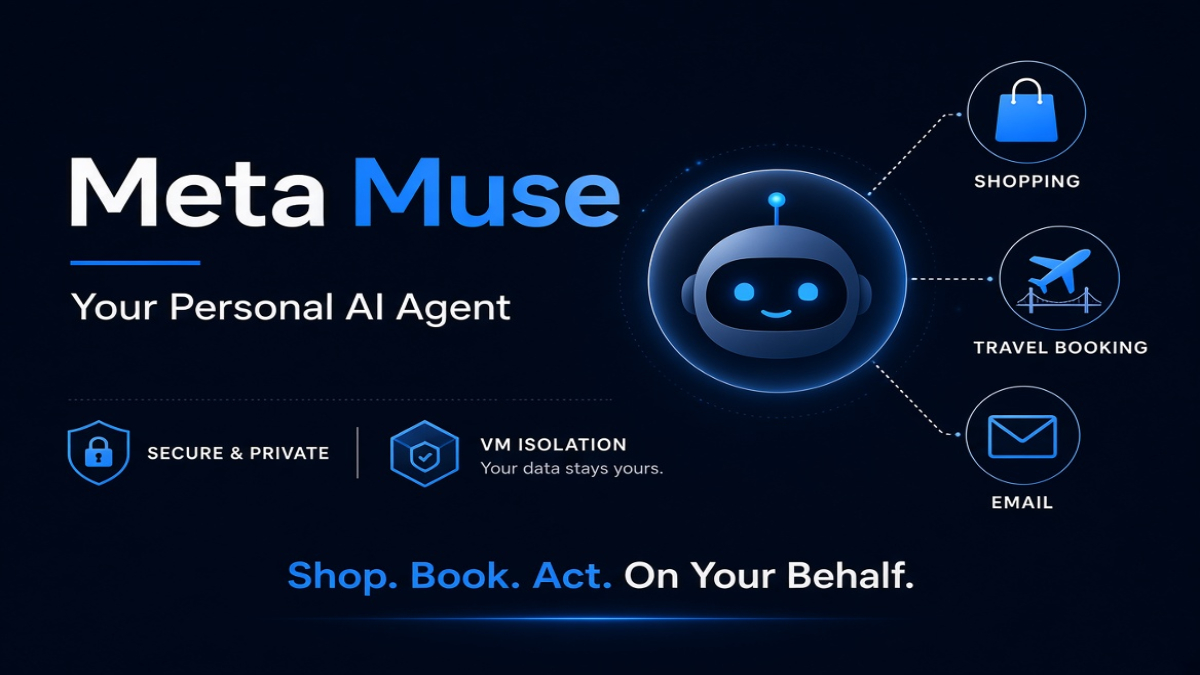
Meta Muse Is Here: The Personal AI Agent That Can Shop, Book Travel and Act for You Meta has moved agentic AI from the chatbot era into a much more consequential phase with Muse, a personal AI agent designed to act on a user’s behalf across everyday digital tasks. Announced on September 8, 2026, Muse is built to do more than answer questions: it can plan goals, use a browser, send emails, book travel, help with purchases, and continue working after the user closes the app. Meta says Muse is powered by Muse Spark and runs inside a dedicated Muse Secure VM designed specifically for agentic work. The launch is a major signal for the AI industry because the definition of an assistant is changing. Traditional chatbots wait for a prompt and return information. An agent can interpret a goal, plan multiple steps, use tools, perform actions, monitor progress, and return when human approval is required. Meta says Muse can work across apps and can ask for approval before sensitive actions such as sending an email or making a purchase. That puts Meta directly into the race to own the consumer task layer of the internet. The technical architecture is especially important. Meta says Muse runs on a dedicated virtual machine containing the agent and the user’s data. A separate Sentinel agent controls internet access and can require permission before actions are taken. Credentials are stored so Muse can use them without directly seeing passwords or payment details. Meta also says users can choose which apps are connected, control permissions, review an audit trail, disconnect services, and opt out of using their interactions to train Meta AI models. A future Confidential VM is planned with encryption controlled by the user. The commerce implications are even bigger. Meta says Muse can complete purchases through Link by Stripe, using a one-time-use card that keeps the user’s actual card details hidden. This creates a direct path from conversational intent to transaction. A shopper could describe what they need, allow the agent to compare options, and then approve a purchase without manually navigating multiple retailer websites. Meta says Shop Pay and 1Password support are also planned. For merchants, this means the customer may increasingly be an AI agent acting for a human. Product pages must therefore become machine-readable, trustworthy, current, and easy to evaluate. Product attributes, prices, availability, shipping, returns, reviews, warranties, and brand reputation will all become inputs into agent decisions. The old model of optimizing only for human browsing and paid clicks will not be enough. Agentic Marketing also changes. Marketers will need to optimize for AI-mediated discovery as well as conventional search and social feeds. A product could win because an agent determines it is the best fit, has reliable fulfillment, and offers a strong return policy—even if the shopper never sees a conventional advertisement. This makes structured data, entity consistency, product feeds, reviews, and trustworthy brand information increasingly important. There is also a major trust challenge. Giving an AI agent access to email, shopping, calendars, and accounts increases the consequences of mistakes. Prompt injection, malicious websites, fraudulent offers, incorrect purchases, and excessive permissions can turn an assistant into a liability. Meta’s VM isolation, Sentinel monitoring, approval gates, credential protection, and audit trails show that agent security is becoming part of the product architecture rather than an afterthought. For businesses, the practical lesson is to prepare now for agent-mediated customers. Audit product data, make policies machine-readable, strengthen identity and authorization controls, test agent-facing shopping journeys, and create approval gates for irreversible actions. Marketing teams should also begin measuring AI-referred discovery rather than relying exclusively on traditional traffic and attribution. The future outlook is a shift from app-centric computing to intent-centric computing. Instead of opening ten applications to accomplish a task, users may increasingly describe the outcome they want and let an agent coordinate the work. Meta has an unusual distribution advantage because Muse can live in a dedicated app and connect to WhatsApp, while Meta controls huge social and messaging networks.
FAQ:
1- What is Meta Muse?
It is Meta’s personal AI agent designed to plan and perform tasks across connected digital services.
2- Can Muse buy products?
Meta says Muse can support checkout through Link by Stripe and requires user approval for sensitive purchases.
3- What is Muse Secure VM?
It is a dedicated virtual machine designed to isolate the agent, credentials, and user data.
4- Why does Muse matter for ecommerce?
It demonstrates how AI agents can become a new interface between consumers and merchants.
Conclusion:
Muse is more than another chatbot release. It is a practical demonstration of where agentic AI is heading: AI that remembers context, uses software, executes tasks, and participates in commerce. Businesses that prepare their data, permissions, product information, and customer journeys for AI agents will be better positioned for the next generation of digital commerce.