
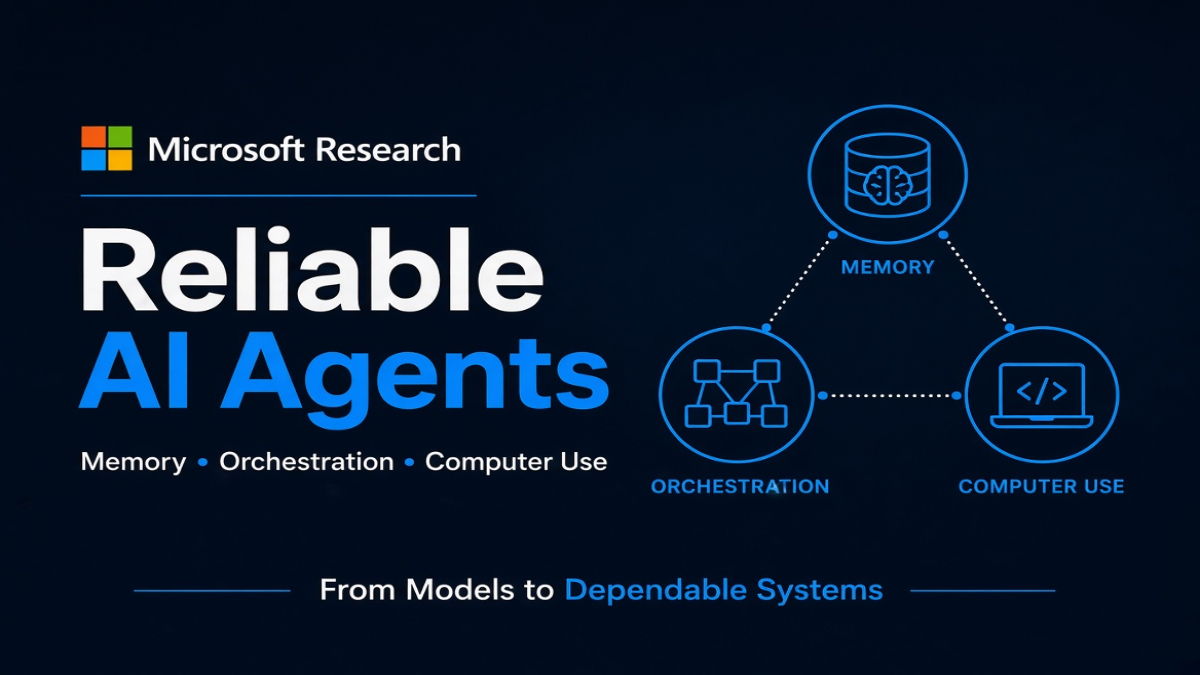
Microsoft Research is placing reliability, orchestration, memory, and computer use at the center of its work on productivity agents. The company’s Agents for Productivity initiative highlights a key reality of enterprise AI: making a model smarter is only one part of building a useful agent. The system must also remember the right information, choose tools correctly, execute workflows reliably, and operate safely in real business environments.
Microsoft says current AI agents still face gaps in reliability, context retention, and real-world workflow execution. Those limitations are important because enterprise work is rarely a single-turn problem. Employees move between applications, documents, emails, spreadsheets, calendars, databases, and internal systems. A productive agent must understand context across those environments and maintain a consistent understanding of the task.
One major focus is orchestration and reasoning. Microsoft Research is working on systems that allow agents to execute long-horizon workflows across Microsoft 365 tools and services. This involves more than connecting an API. The agent must decide which tool to use, when to use it, what information to pass, and whether the result is good enough to continue.
This is the foundation of agentic AI. A chatbot mainly produces an answer. An agent must manage a process. That process can include planning, retrieval, tool use, verification, error recovery, and communication with a human. Each additional step creates another opportunity for failure, which is why orchestration is becoming a critical layer of the AI stack.
Memory is another major issue. Microsoft describes work on procedural memory and context management so agents can preserve useful knowledge across sessions and projects. For enterprise applications, memory must be carefully scoped. An agent should remember the information needed for a user’s workflow without accidentally exposing sensitive information across teams or contexts.
Computer use is equally important. Many business applications still do not expose every capability through clean APIs. Agents that can reliably operate graphical interfaces could automate tasks across older or fragmented software systems. However, computer-use agents also introduce safety challenges because an incorrect click can produce a real-world consequence.
These research directions have major implications for Agentic Marketing. Marketing teams operate across CRM platforms, advertising systems, analytics tools, content management systems, social networks, spreadsheets, and communication applications. A reliable marketing agent needs to coordinate across those environments while preserving context about customers, campaigns, brand guidelines, and approvals.
Agentic Commerce is another natural application. A commerce agent could potentially search catalogs, compare products, analyze inventory, coordinate customer-service workflows, and assist with order management. To do this safely, the agent needs strong memory controls, reliable tool orchestration, and clear permissions.
The enterprise challenge is therefore becoming one of system engineering. Companies need an architecture that combines models, agents, tools, memory, identity, permissions, observability, evaluations, and human oversight. A powerful model without those components may remain a fascinating demo rather than a dependable business system.
Microsoft’s research also emphasizes realistic evaluation environments. This is critical because standard AI benchmarks do not fully measure agent reliability. Businesses need tests that reproduce actual work: completing a multi-step task, handling a missing input, recovering from a failed tool call, respecting permissions, and asking for human approval when required.
For AI leaders, this suggests a practical roadmap. First, select a workflow with a clear business outcome. Second, map every tool and data dependency. Third, define what the agent can do autonomously and what requires approval. Fourth, create test cases for normal and failure scenarios. Fifth, monitor completion quality and human intervention. Only then should the workflow be expanded.
The larger significance of Microsoft’s approach is that the agentic AI race is becoming less about the model alone. The next generation of AI systems will depend on orchestration, memory, tool integration, computer use, security, and evaluation. These layers determine whether an agent can move from an impressive prototype to dependable digital labor.
For businesses, the message is clear: reliable agents will be built as systems, not prompts. Companies that invest in the surrounding infrastructure may gain more practical value from AI than those that focus only on selecting the newest model. Microsoft’s Agents for Productivity research is a strong signal that this systems-level engineering challenge is now one of the central frontiers of enterprise AI.