News hook
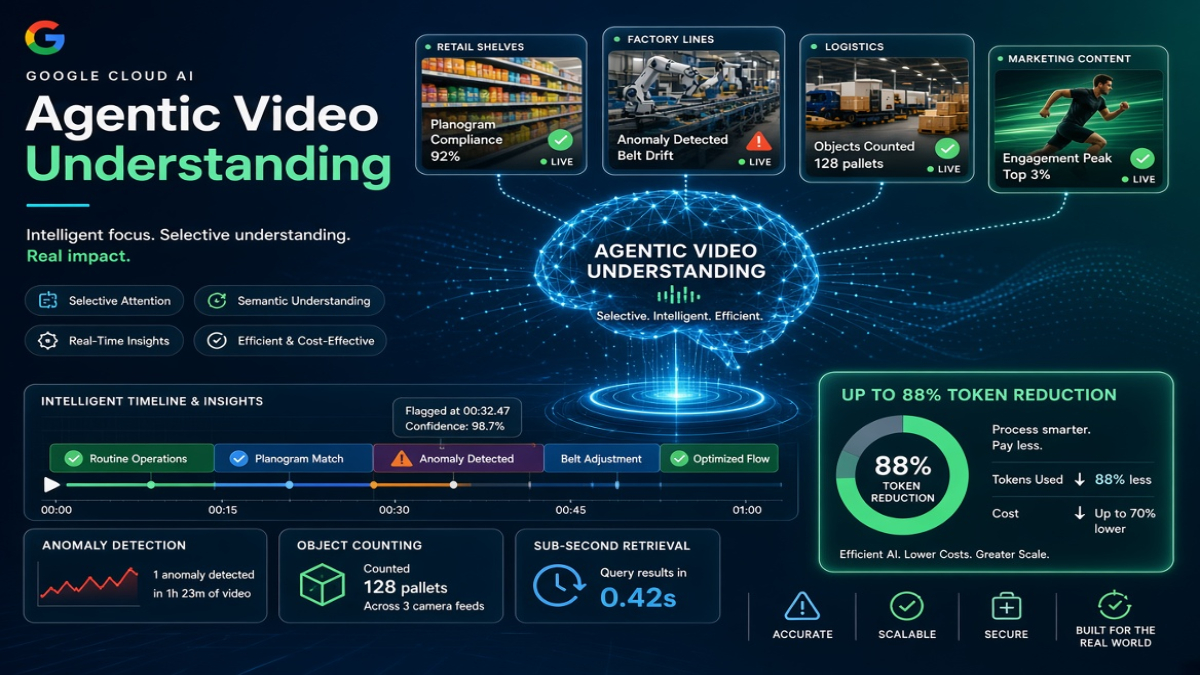
Google Gemini has launched agentic video understanding across Gemini 3.7 Flash, Gemini 3.6 Flash, and Gemini 3.5 Flash-Lite. Google says the feature can cut token consumption by up to 88%, reduce costs by up to 66%, and improve quality by up to 7% for video analysis. The launch matters because it turns video from an expensive passive input into a more efficient source of structured, searchable, and actionable intelligence.
What happened
Google describes agentic video understanding as a system that uses Gemini’s native video tools more strategically. Instead of treating every frame as equally important, the model can reason about what to inspect, retrieve precise moments, detect anomalies, count objects, and analyze events with more targeted computation.
The new capability supports sub-second moment retrieval, more accurate anomaly detection, and precise counting. It builds on Google’s earlier agentic vision work, which combines code execution with native image understanding. In video, the result is a workflow that is not just “watching” content. It is selecting evidence, asking focused questions, and extracting the information needed for a task.
Why it matters
Video is everywhere in modern business, but most organizations cannot analyze it continuously because of cost, latency, and infrastructure limits. Retailers have cameras, brands have social video, logistics companies have vehicle footage, factories have inspection feeds, and enterprises have hours of meetings and training recordings.
A large reduction in token use changes the economics. More video can be processed, more frequently, and for more specialized use cases. The opportunity is not only to summarize video. It is to connect video insights to workflows.
Technical and business analysis
The technical breakthrough is selective computation. A multimodal model becomes more efficient when it can locate the relevant time window, use specialized tools, and avoid reprocessing irrelevant footage. That is an agent pattern: observe, decide what to inspect, call the right capability, verify the result, and produce an answer.
For businesses, this means video pipelines can become event-driven. Instead of analyzing every second of every camera feed, the system can watch for specific conditions and then zoom in. That lowers cost and makes real-time or near-real-time monitoring more practical.
Agentic AI implications
Agentic video extends the scope of AI agents into the physical and visual world. An agent can detect an issue, classify it, cross-reference metadata, and trigger the next step. In manufacturing, it could flag a defect and open a maintenance ticket. In logistics, it could identify a delivery exception. In security, it could prioritize an incident for human review.
Agentic Commerce implications
Commerce applications are especially strong. Retailers can analyze shelf availability, queue length, store traffic, product placement, and customer interactions. E-commerce brands can understand how creators demonstrate products, identify which moments drive engagement, and improve merchandising decisions.
Agentic Marketing implications
For marketing teams, agentic video can monitor brand mentions, detect competitor appearances, extract product moments, and evaluate whether a video follows a campaign brief. It can also help generate searchable metadata and identify which scenes should be repurposed into short-form content.
Practical business takeaways
Start with one well-defined video task, such as anomaly detection, compliance checking, or content indexing. Define acceptable error rates and privacy boundaries. Use human review for high-impact decisions. Measure cost per analyzed hour, latency, precision, recall, and downstream business value.
Future outlook
As video understanding becomes cheaper and more selective, businesses will treat video as an operational data source rather than just media. The next step will be multimodal agents that combine video, text, audio, sensor data, and enterprise systems into one decision loop.
FAQ
What is agentic video understanding?
It is a video-analysis approach where the AI decides what to inspect and which tools to use instead of processing every frame equally.
How much more efficient is Google’s system?
Google reports up to 88% lower token usage, up to 66% lower costs, and up to 7% higher quality in supported scenarios.
What industries can benefit?
Retail, manufacturing, logistics, security, media, healthcare, education, and marketing.
Can it automate decisions?
It can support workflows, but businesses should use human approval for sensitive or high-impact decisions.
Why is this important for marketers?
It makes large-scale video analysis more affordable for campaign measurement, content tagging, and creative optimization.
Conclusion
Google’s agentic video launch shows that multimodal AI is entering an efficiency phase. The most valuable systems will not simply understand more video; they will understand the right video at the right moment and connect that insight to action. That is a major step forward for agentic AI, commerce, and marketing.