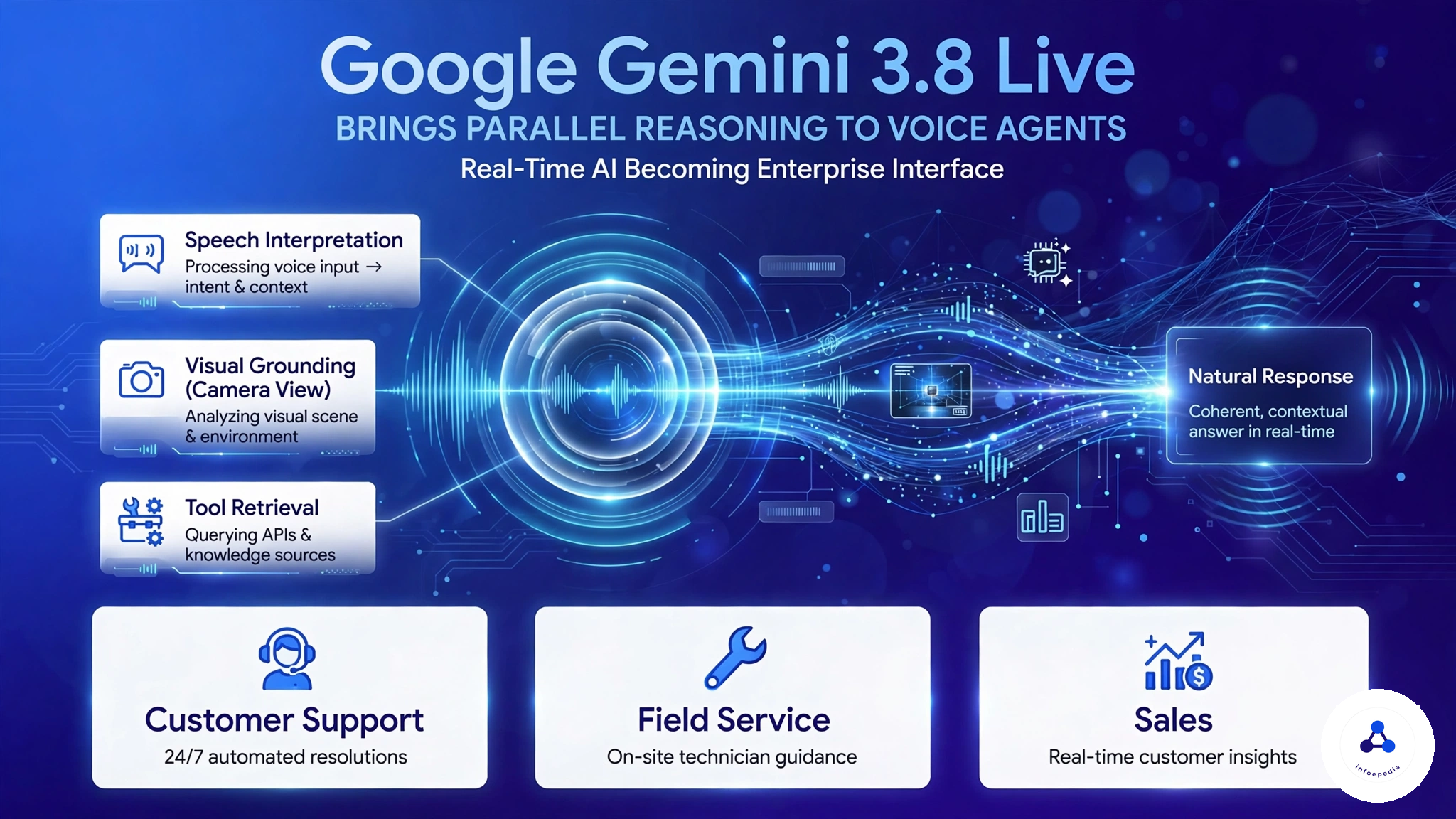
Google has introduced Gemini 3.8 Live and Gemini 3.8 Live Extended Thinking, describing them as its most advanced live dialogue models yet. The models are designed for fluid voice interaction, visual grounding, parallel reasoning, and complex multi-step tasks, giving developers stronger building blocks for production-ready voice agents.
What happened
Google says Gemini 3.8 Live is optimized for scale and cost efficiency, while the Extended Thinking version is designed for higher-complexity tasks that require deeper reasoning. The update is aimed at near-real-time collaboration, enabling voice agents to respond naturally while also interpreting visual context and handling more complex chains of thought.
The significance is not limited to voice assistants. Live dialogue models can become the interaction layer for customer support, field service, sales qualification, training, accessibility, and operational workflows. In these environments, the system must do more than transcribe and answer. It must understand intent, maintain context, decide when to ask a question, retrieve information, and coordinate tools without making the user wait unnecessarily.
Why it matters
Voice remains one of the most natural interfaces for many users, but enterprise voice systems have traditionally struggled with latency, interruption handling, domain accuracy, and long conversations. A stronger real-time model can reduce these limitations. The user can speak naturally, correct themselves, show an image, change direction, and still receive an answer that is responsive and grounded.
For businesses, this matters because the interface is often the bottleneck. Many workflows are technically automatable but practically difficult when users must navigate forms, menus, or fragmented applications. Voice agents can make those workflows more accessible and more efficient.
Technical and business analysis
The phrase “parallel reasoning” is especially important. A live agent cannot afford to perform every task strictly one after another. It may need to interpret speech, inspect visual input, retrieve data, and prepare a response at the same time. Parallel processing can reduce latency and improve the feeling of natural conversation.
However, speed alone is not enough. Voice agents need strong interruption policies, uncertainty handling, and tool governance. If the agent is unsure about an account change, a refund, or a medical instruction, it should pause and ask for confirmation rather than guessing. In production, confidence thresholds and escalation rules will be as important as the model itself.
Agentic AI implications
Gemini 3.8 Live strengthens the case for voice-first agents that operate as active collaborators. A customer-support agent could listen, search a knowledge base, inspect account history, and summarize next steps while the conversation is still underway. A field technician could describe a problem, show a component through a camera, and receive guided instructions.
Agentic Commerce implications
In agentic commerce, voice agents can support discovery, comparison, and post-purchase service. A shopper might describe a need conversationally, show a room or product, and ask the agent to compare compatible options. The voice agent could then check stock, explain trade-offs, and prepare a cart. The key is to preserve user agency and make the transition from recommendation to purchase explicit.
Agentic Marketing implications
Voice changes how brands think about marketing. The interaction becomes less about broadcasting a message and more about understanding intent in real time. An agent could answer questions about a product, adapt the explanation to the user’s knowledge level, and hand off high-value leads to a sales representative. Marketing teams should think in terms of conversational journeys, not just content assets.
Practical business takeaways
Start with bounded use cases where voice adds clear value: support triage, appointment booking, product education, or internal knowledge assistance. Design for interruptions and errors. Provide citations or evidence where appropriate. Log decisions and tool usage. Measure task completion, containment rate, transfer quality, latency, and customer satisfaction.
Future outlook
Real-time voice agents are likely to become a primary interface for software, especially in mobile, industrial, and customer-service settings. The next wave will combine voice with visual context, action execution, and personalized memory. As this happens, companies will compete on the quality of their workflows and data, not merely the fluency of the model.
FAQ
What are Gemini 3.8 Live models?
They are Google’s latest live dialogue models for real-time voice interaction, with one version focused on scale and another on deeper reasoning.
Why is parallel reasoning useful?
It allows the system to process conversation, context, tools, and visual information simultaneously, reducing delays.
Where can businesses use live voice agents?
Customer service, sales qualification, field support, training, accessibility, and operational assistance.
What is the main risk?
A fast agent can still make unsafe or incorrect decisions if confidence, permissions, and escalation rules are weak.
Conclusion
Gemini 3.8 Live shows that the next enterprise AI interface may not be a dashboard or a chat box. It may be a live conversation that can see, reason, and act. Businesses that prepare their data, workflows, and governance now will be better positioned to turn real-time voice from a demo into durable operating capability.