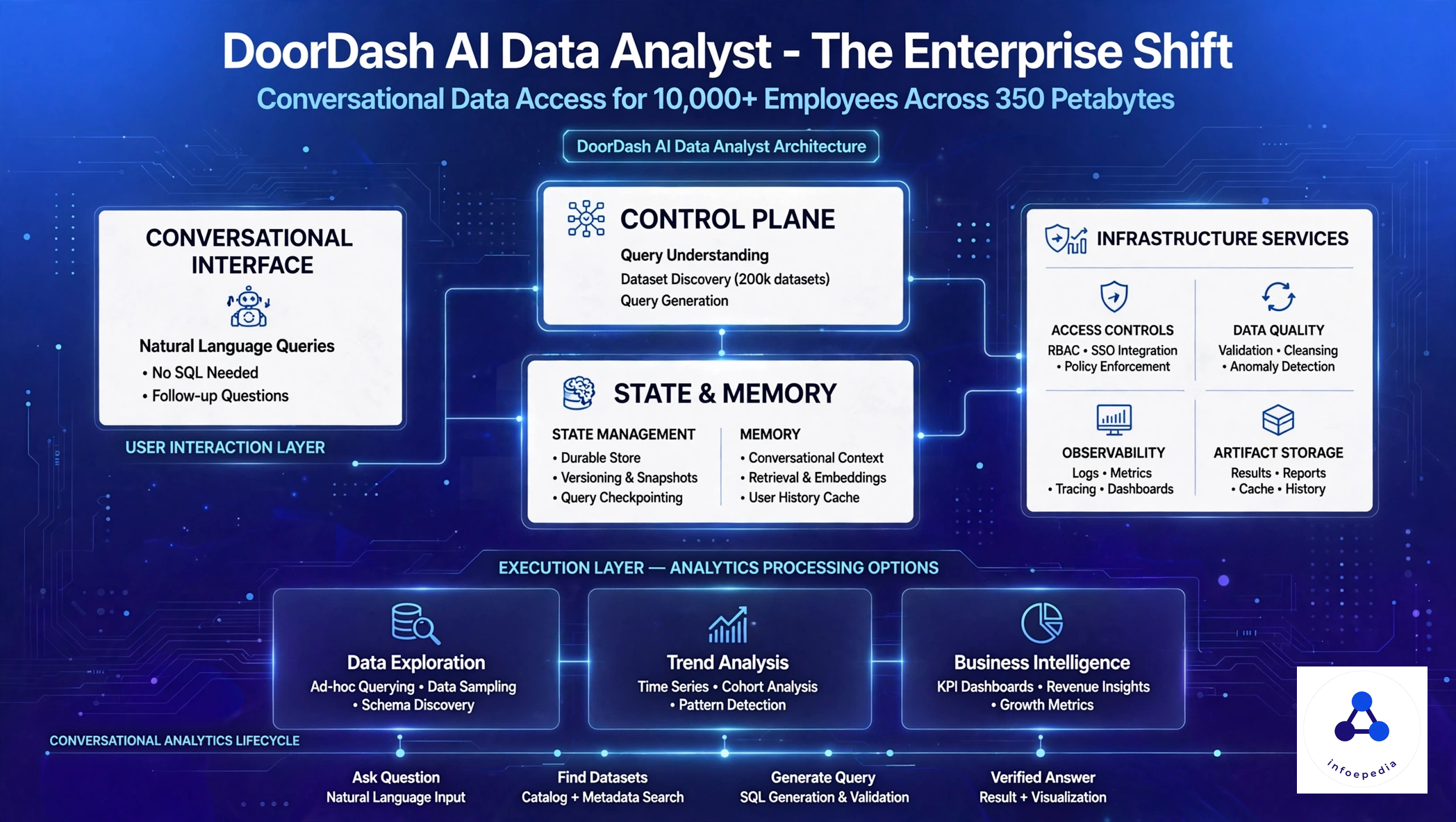
DoorDash Deploys an AI Data Analyst for More Than 10,000 Employees. DoorDash has deployed an internal AI data analyst for more than 10,000 employees, allowing teams to ask questions about company data using everyday language. The system can work across roughly 200,000 datasets and 350 petabytes of information, giving employees a simpler way to find answers and understand business data.
What happened
DoorDash built the internal AI data analyst to help employees work with the company’s large and complex data environment. Instead of writing SQL queries or searching through different data sources, employees can ask questions in a conversational way and receive data-driven answers.
The system works across around 200,000 datasets and 350 petabytes of information. This gives teams a faster way to explore business data, investigate trends, and support everyday decisions.
The deployment also shows how enterprise AI is moving beyond simple chatbots. Companies are increasingly using AI systems to connect employees with internal data and make data analytics automation part of daily work.
Why it matters
Large companies often have huge amounts of data, but having data does not always mean employees can easily use it. Finding the right dataset, understanding its structure, and writing the correct query can take time.
DoorDash’s approach makes conversational data analysis available to a much larger group of employees. A team member can describe what they want to know in normal language instead of depending on technical tools or waiting for a custom analysis.
This can reduce the time between asking a business question and finding an answer. It also gives employees a more direct way to use the information already available inside the company.
Technical and business analysis
Building an AI data analyst for an environment this large is more complicated than connecting a chatbot to a database. The system needs to understand the employee’s question, identify the relevant data, select the right datasets, generate an appropriate query, and return an answer that can be checked.
Data quality is another important issue. With hundreds of thousands of datasets, the system needs enough information about each dataset to understand what it contains and how it should be used. Access controls are also important because not every employee should be able to see every type of company information.
For businesses, the main value comes from reducing the work needed to reach useful information. Data teams can spend more time on complex analysis while employees handle simpler questions themselves.
AI data analyst implications
The DoorDash example points to a broader shift in AI data analytics. An AI analyst is not limited to producing a single number. It can help employees explore information, identify patterns, compare results, and ask follow-up questions.
This conversational approach can make business intelligence easier for people who do not have strong technical skills. However, employees still need to understand where the information comes from and check important results before using them for major decisions.
The quality of the underlying data remains just as important as the AI system itself. If the source data is incomplete or incorrect, a well-written answer can still lead to the wrong conclusion.
Agentic AI implications
The DoorDash example also shows how AI agents can become useful inside large organizations. An AI data analyst can potentially move beyond answering questions and support multi-step analytical tasks.
For example, an employee could ask the system to investigate a drop in sales, compare different markets, identify possible causes, and prepare a summary. As these systems become more capable, they may take on more parts of the research and analysis process.
This also increases the need for clear permissions, reliable data sources, and human review. An AI system should not automatically make important business decisions simply because it can access large amounts of information.
Agentic Commerce implications
For commerce companies, conversational AI data analytics can help teams understand orders, customers, delivery performance, inventory, pricing, and other business information.
A commerce team could use an internal AI analyst to compare sales across markets, investigate changes in customer behavior, or identify problems in the ordering process. When connected with other business systems, these tools could eventually support more automated decision-making.
However, sensitive customer and financial information requires strict access controls. AI systems should only provide employees with the data they are authorized to use.
Agentic Marketing implications
Marketing teams can also benefit from an AI data analyst connected to internal business data. Teams could ask questions about campaign performance, customer behavior, conversion rates, advertising costs, and content performance without manually collecting information from multiple systems.
This could make marketing analytics automation faster and easier. Instead of spending time gathering reports, marketers could spend more time understanding why results changed and deciding what to test next.
At the same time, marketing teams need to make sure the system does not expose customer information or create misleading conclusions from incomplete campaign data.
Practical business takeaways
- Give employees simple ways to access business data without requiring advanced technical skills.
- Connect AI tools only to approved and well-documented data sources.
- Maintain strong access controls for sensitive information.
- Make AI-generated analysis easy to verify and trace back to its source.
- Keep human review for important business decisions.
- Start with useful internal workflows before expanding AI access across the organization.
- Treat data quality as a core part of any enterprise AI project.
Future outlook
DoorDash’s internal AI data analyst reflects a growing move toward AI-powered business intelligence. As companies collect more data, the challenge is increasingly about helping employees use that information quickly and correctly.
The next stage could see AI analysts working across databases, dashboards, documents, and business applications. Instead of simply answering questions, they may help employees investigate problems, prepare reports, and complete routine analysis.
For large organizations, this could make data access a normal part of everyday work rather than a task limited to specialized data teams.
FAQ
What is DoorDash’s AI data analyst?
It is an internal AI system that allows DoorDash employees to ask questions about company data conversationally.
How many employees can use it?
The system has been deployed for more than 10,000 employees.
How much data does it cover?
It provides access across roughly 200,000 datasets and 350 petabytes of information.
Why is conversational data analysis useful?
It allows employees to ask questions in natural language instead of writing technical queries or depending on a data analyst for every request.
Does an AI data analyst replace human data analysts?
Not necessarily. It can handle routine questions and analysis while human data teams can focus on more complex work, data quality, and high-impact decisions.
Conclusion
DoorDash’s deployment of an AI data analyst shows how companies are changing the way employees work with internal information. Giving more than 10,000 employees conversational access to around 200,000 datasets and 350 petabytes of data can make business intelligence more accessible across the organization.
As enterprise AI develops, the value may come not only from generating content or answering questions, but from helping employees work directly with the data behind their businesses. Companies that combine easy data access with strong controls and reliable information will be better prepared for the next stage of AI-powered work.