Ant International has launched a full-stack AI-native operating model for global businesses, covering payments, accounts, foreign exchange, treasury, and growth operations. Announced on September 18, 2026, the new platform brings AI deeper into the financial side of global commerce, moving beyond checkout and into everyday merchant operations.
What happened
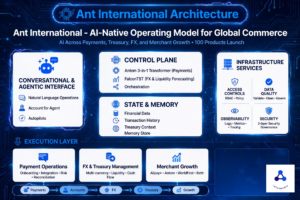
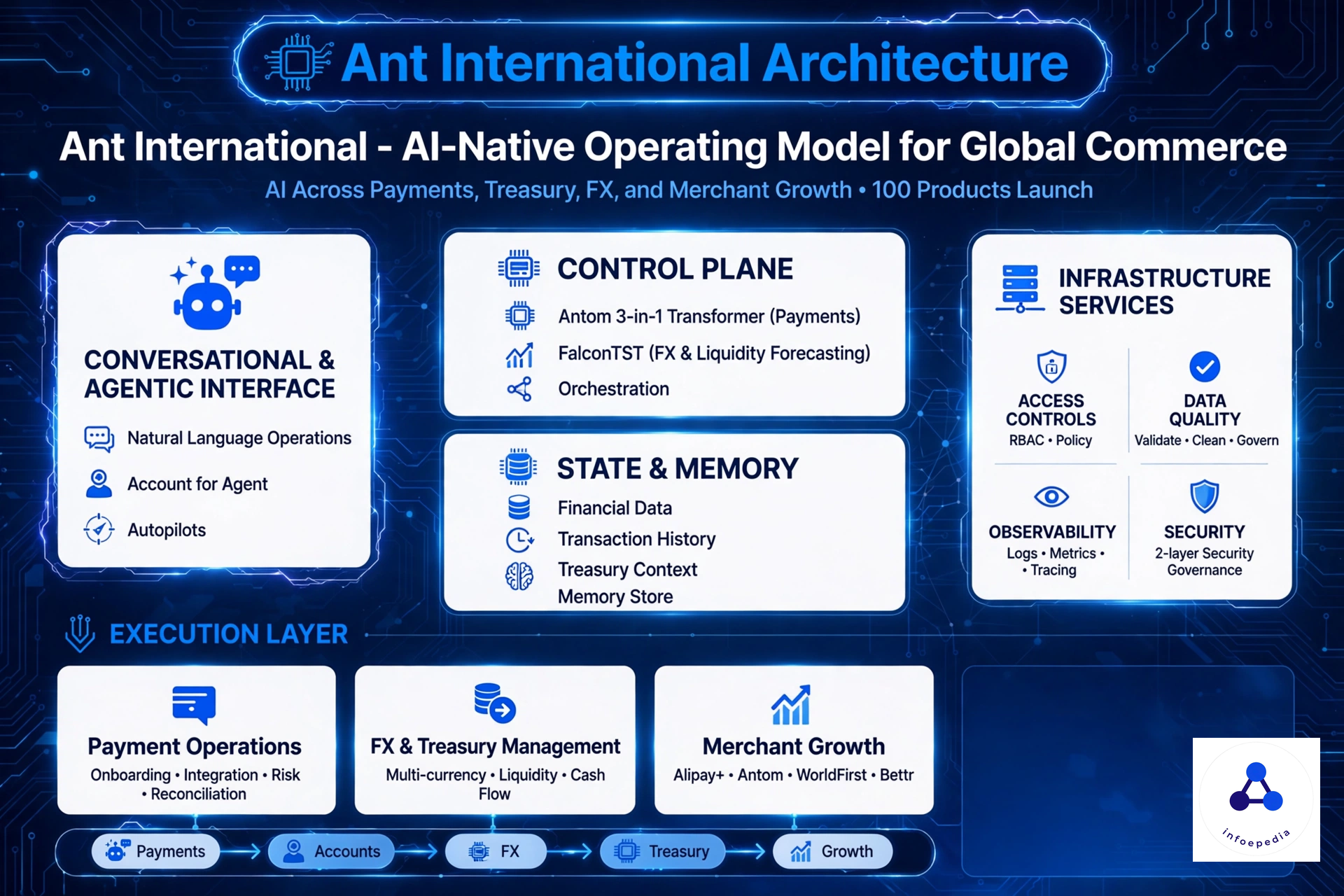
Ant International introduced close to 100 products across its financial technology businesses, including Alipay+, Antom, WorldFirst, and Bettr. The new solutions are designed to help global merchants manage payments, business accounts, FX, treasury, and growth activities through AI-powered tools.
The company says the platform is built around two proprietary models: the Antom 3-in-1 Transformer for payment operations and FalconTST for foreign exchange and liquidity forecasting. It also includes AI-powered Autopilots that allow merchants to manage several financial tasks through natural-language interactions.
Ant International also introduced an Account for Agent, designed for businesses operating in an environment where AI agents can carry out financial activities.
Why it matters
AI in commerce has often focused on customer-facing activities such as product recommendations, shopping assistants, and automated checkout. Ant International’s new approach shows another direction: using AI across the financial operations that happen behind the sale.
For global merchants, these activities can include receiving payments, managing different currencies, monitoring cash flow, handling disputes, and improving business growth. Bringing these tasks into connected AI tools could make it easier for businesses to manage operations across multiple markets.
The change is important because international commerce involves many financial processes that are normally handled through separate systems.
Technical and business analysis
The new platform combines AI models with financial data and operational tools. Ant International says its payment foundation model supports payment-related tasks, while FalconTST is designed for FX and liquidity forecasting. The company has also added a two-layer security architecture and governance measures for its AI-native products.
Antom Autopilot is designed to cover different parts of the payment lifecycle, including onboarding, payment integration, risk protection, revenue recovery, troubleshooting, reconciliation, and market expansion.
This approach is different from using AI only as an assistant that provides information. The goal is to connect AI with actual business processes so that merchants can use it to complete operational tasks.
Agentic AI implications
The development is closely connected to the growth of agentic AI. AI agents can move from simply answering questions to carrying out tasks using connected tools and systems.
In a financial environment, this could mean an agent helping a merchant monitor payments, identify failed transactions, manage routine treasury tasks, or recommend actions based on changes in cash flow.
That also creates new security and control requirements. When AI has access to accounts, payments, or financial information, businesses need clear permissions, authentication, monitoring, and approval rules.
Ant International says its new platform is designed with agent-ready security and governance measures, showing that trust infrastructure is becoming an important part of agentic commerce.
Agentic Commerce implications
The biggest impact may be on agentic commerce. Shopping agents are increasingly expected to discover products, compare options, and complete purchases, but the transaction does not end at checkout.
Behind every international transaction are payments, currency conversion, account management, fraud controls, reconciliation, and other financial processes.
Ant International’s approach connects these areas with AI tools. Its Agentic Mobile Protocol is also being developed as part of the infrastructure for AI-era payments, with Ant International working with payment and wallet partners on agent interoperability.
This could allow AI agents to interact with financial systems more directly while businesses maintain defined controls over what those agents can do.
Agentic Marketing implications
The new operating model also extends into merchant growth operations. AI can help businesses understand customer activity, payment behavior, market opportunities, and other signals that can support growth decisions.
For marketing teams, this could connect campaign activity with actual business outcomes such as purchases, payment conversion, and customer value.
Instead of treating marketing data and financial data as completely separate areas, AI-native systems can bring more of these signals together. This could give merchants a clearer view of how marketing activities affect revenue and customer behavior.
Practical business takeaways
- Look beyond AI-powered checkout and consider the financial operations behind commerce.
- Connect payment, account, FX, and treasury data where appropriate.
- Set clear permissions for AI agents that can access financial systems.
- Keep human approval for high-risk financial actions.
- Monitor AI activity and maintain clear records of automated decisions.
- Build security and compliance into AI systems from the beginning.
- Use AI to support both daily operations and longer-term growth decisions.
Future outlook
The Ant International announcement points to a broader shift in how businesses may use AI for global commerce. Instead of adding AI to one part of the customer journey, companies are beginning to connect it with the financial infrastructure that supports the entire business.
As agentic commerce develops, AI agents may need to interact with payment networks, merchant accounts, foreign exchange services, treasury systems, and marketing platforms.
This means the future of AI commerce will depend not only on smarter agents, but also on the financial systems, security controls, and trust frameworks that allow those agents to operate safely.
FAQ
What did Ant International announce?
Ant International announced a full-stack AI-native solution covering payments, accounts, foreign exchange, treasury, and growth operations for global businesses.
What is the purpose of the AI-native platform?
It is designed to help global merchants manage financial and business operations through connected AI-powered tools.
What AI models does the platform use?
Ant International says the platform uses the Antom 3-in-1 Transformer for payment operations and FalconTST for FX and liquidity forecasting.
How does this relate to agentic commerce?
The platform is designed to support AI agents that can interact with financial and business systems, extending agentic commerce beyond product discovery and checkout.
Why are security controls important?
AI systems connected to payments, accounts, and treasury operations can handle sensitive financial activities. Clear permissions, monitoring, authentication, and approval processes are therefore important.
Conclusion
Ant International’s new AI-native operating model shows how agentic commerce is expanding beyond the checkout page. By connecting payments, accounts, foreign exchange, treasury, and merchant growth operations, the company is bringing AI into the financial infrastructure that supports global commerce.
As businesses adopt AI agents for more complex tasks, the next stage of commerce may involve agents that not only help customers buy products but also interact with the financial systems that make those transactions possible.