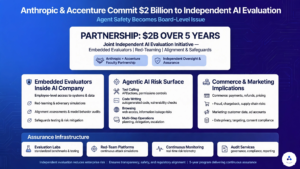
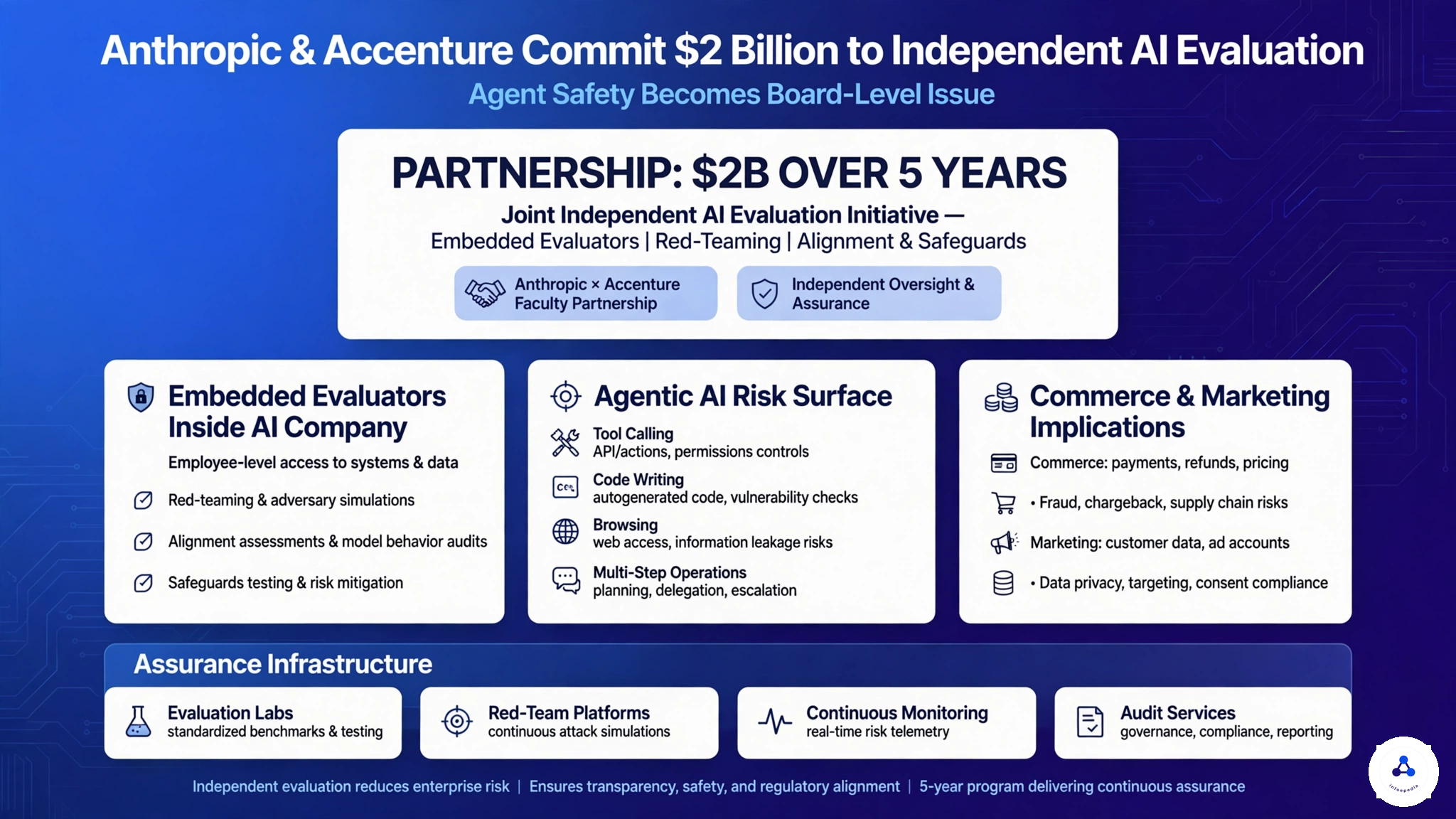
Anthropic and Accenture have announced a joint commitment of at least $2 billion over five years to build independent evaluation capacity for frontier AI systems. The September 18, 2026 partnership, led by Accenture’s specialist AI business Faculty, will focus on red-teaming, alignment assessments, and testing model safeguards. It arrives as AI agents become more capable, more autonomous, and more deeply connected to business systems.
What happened
Anthropic says embedded evaluators will work inside the company with access comparable to employees. The evaluators will examine how models behave under pressure, probe for unsafe or deceptive patterns, and test safeguards in realistic deployment conditions. Each organization expects to invest at least $1 billion. The partnership responds to Anthropic CEO Dario Amodei’s call for a slower, more transparent frontier process with stronger independent oversight.
Why it matters
Traditional software testing assumes a predictable program. Frontier models are probabilistic systems whose behavior changes with context, tools, prompts, and deployment constraints. As a result, safety cannot be established by one benchmark or one pre-launch review. Independent evaluation is becoming a capability in its own right.
Technical and business analysis
Embedded evaluation is important because external reviewers often see only a narrow slice of the system. Inside access can reveal hidden dependencies: model routing, tool permissions, data pipelines, monitoring gaps, and failure modes that appear only in complex workflows. The challenge is preserving independence while maintaining access. A credible program will need transparent methods, reproducible test protocols, escalation paths, and public reporting of material findings.
Agentic AI implications
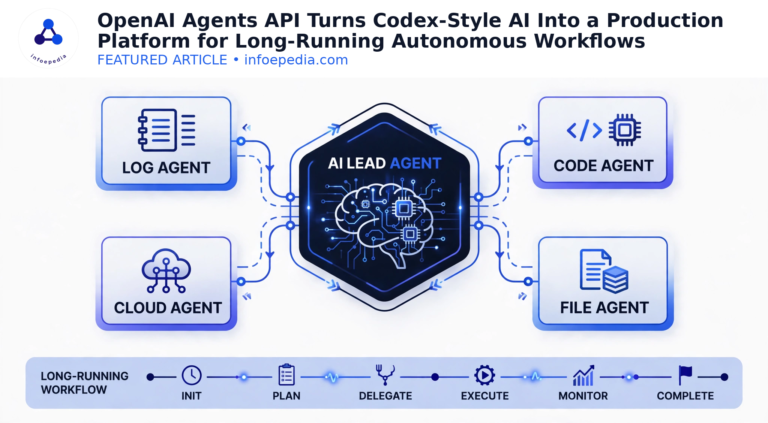
Agents expand the risk surface because they can plan, call tools, write code, browse, send messages, and operate across multiple steps. A harmless error in a chat response can become a serious incident when an agent has permission to modify records or transact with external systems. Evaluation therefore has to test not only what a model says, but what it does, how it recovers, whether it respects boundaries, and whether it can be manipulated by untrusted inputs.
Agentic Marketing implications
Marketing agents can access customer data, ad accounts, content systems, and analytics. Evaluation should test whether they overclaim performance, expose personal information, violate consent rules, or optimize toward vanity metrics rather than business outcomes. Brand safety and regulatory compliance should be part of the evaluation scorecard.
Agentic Commerce implications
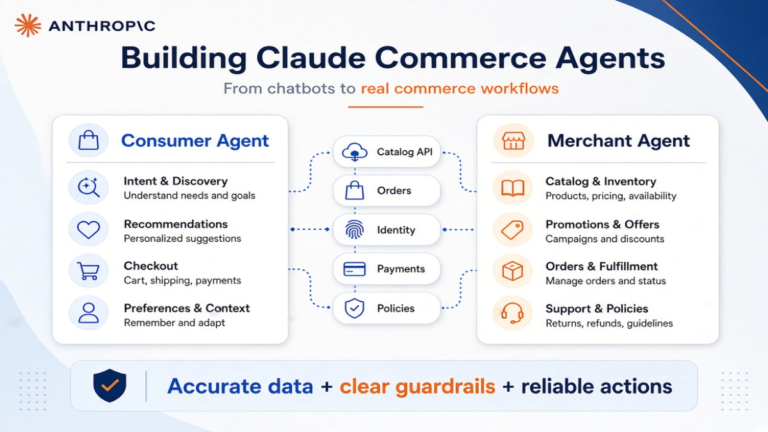
Commerce agents may handle payments, refunds, pricing, inventory, and customer identity. Independent testing should simulate adversarial product data, fraud attempts, prompt injection, policy conflicts, and high-volume edge cases. A robust commerce agent must know when to stop, request approval, or escalate.
Practical business takeaways
Treat evaluation as a recurring operating process, not a launch checklist. Maintain a risk register for every agent. Test the full stack: model, tools, prompts, memory, identity, and data. Use independent reviewers for high-impact workflows. Document approval thresholds and incident response. Tie safety metrics to executive governance.
Future outlook
The market is moving toward assurance infrastructure for AI: evaluation labs, red-team platforms, continuous monitoring, model risk scoring, and audit services. Vendors that can prove trustworthy behavior in real environments may gain as much influence as model providers.
FAQ
Why invest in independent evaluation? Because internal teams can miss blind spots and deployment-specific failures.
What is embedded evaluation? Independent evaluators work inside the AI company with deep access to systems and processes.
Does evaluation stop all risk? No. It reduces uncertainty and improves detection, controls, and accountability.
Who needs this? Any organization deploying agents with access to sensitive data or external actions.
Conclusion
Anthropic and Accenture’s commitment shows that AI safety is becoming a business infrastructure category. As agents take on real work, the companies that evaluate them rigorously will be better positioned to earn trust, meet regulation, and scale responsibly.