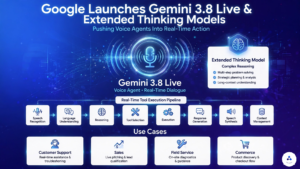
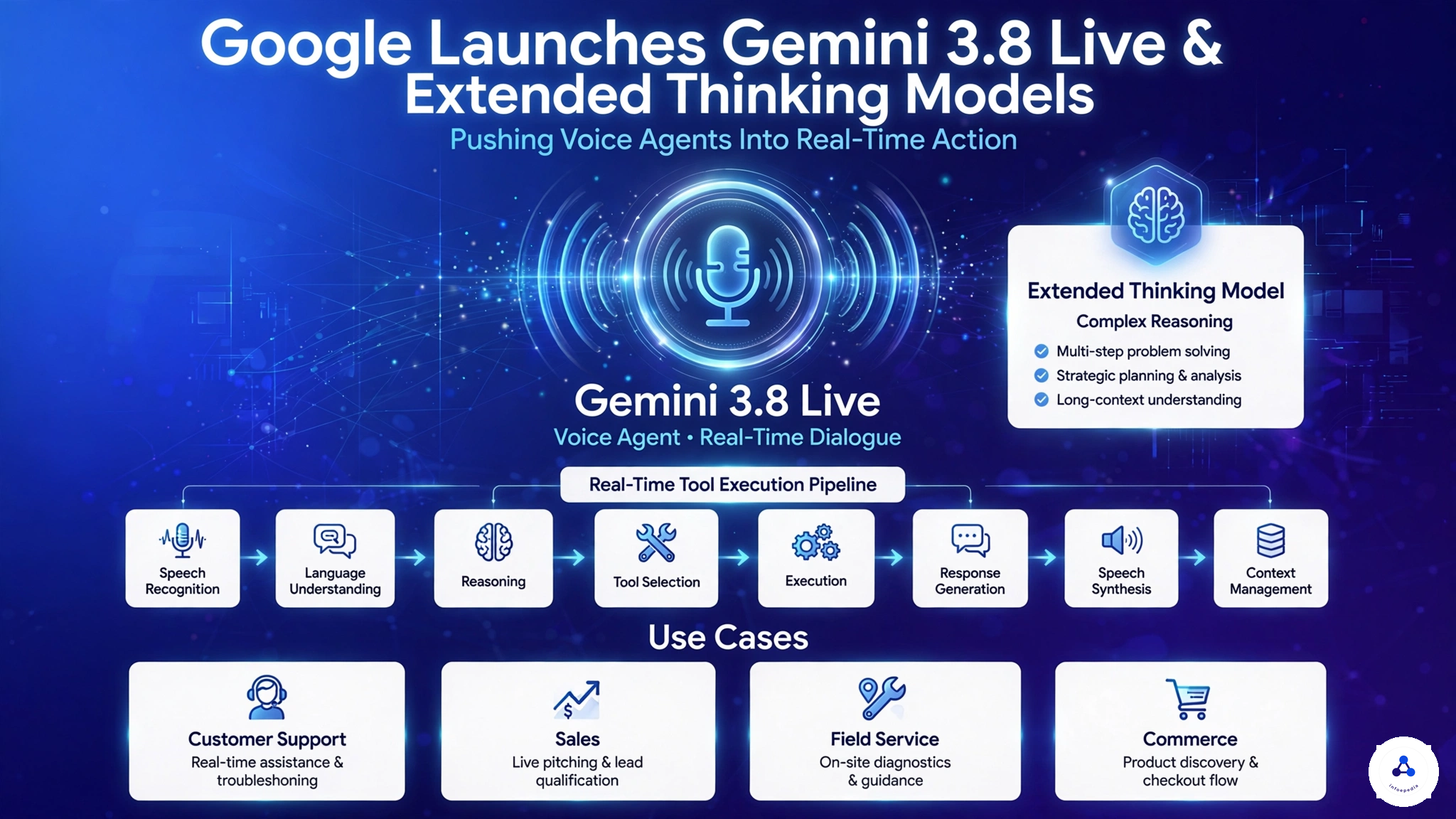
Google has introduced Gemini 3.8 Live and Gemini 3.8 Live Extended Thinking, new real-time dialogue models designed to make voice agents more capable, responsive, and useful in complex workflows. Released September 15, 2026 through the Gemini API and Google AI Studio, the models target a growing market where AI assistants are expected not only to talk naturally but also to reason, maintain context, use visual grounding, and execute tasks.
What Happened
Google describes Gemini 3.8 Live as a model optimized for fluid, near-real-time speech-to-speech interactions, while the Extended Thinking version focuses on higher-complexity requests that require deeper reasoning and multi-step problem solving.
Google says the models are designed for developers building voice-first experiences and production-ready voice agents. Gemini 3.8 Live can maintain dialogue while performing tasks, and the Extended Thinking model adds stronger reasoning for more complex interactions. Google also introduced Gemini 3.5 Transcribe, a dedicated speech-to-text model with support for more than 85 languages.
The announcement matters because the voice interface is becoming one of the most natural entry points for agentic systems. A typed chatbot can answer a request. A voice agent can potentially listen while the user is moving, ask clarifying questions, consult tools, and complete the workflow without forcing the person to switch between applications.
Why It Matters
The business significance of real-time voice AI is not only about sounding more human. The important capability is continuous task execution through conversation.
In a traditional voice bot, every step is usually pre-scripted. In an agentic voice system, the model can interpret the request, decide which tools are necessary, and adapt to the conversation.
That can transform customer support, sales, field service, healthcare administration, hospitality, education, and many other workflows.
For enterprises, voice agents can also reduce the friction of accessing software. A user may say, “Check today’s sales performance, compare it with last week, and prepare a summary for the 4 p.m. meeting.” The agent can potentially combine conversation, retrieval, analysis, and task execution in one experience.
Technical and Business Analysis
Voice agents are technically challenging because several time-sensitive systems must work together:
1. Speech recognition
2. Language understanding
3. Reasoning
4. Tool selection
5. Tool execution
6. Response generation
7. Speech synthesis
8. Context management
Latency matters at every layer. A system that pauses too long after every question feels broken even if its reasoning is excellent.
That is why Google emphasizing real-time dialogue, cost efficiency, and parallel reasoning is strategically important. Agentic systems often make multiple model and tool calls, so latency and token cost compound quickly.
The addition of Gemini 3.5 Transcribe is also noteworthy. A dedicated transcription layer can be used in workflows where accurate speech capture is more important than a generic multimodal model.
Agentic AI Implications
Gemini 3.8 Live strengthens the idea that the next generation of agents will not be limited to text. Voice becomes another control surface for an autonomous system.
A voice agent can manage reservations, qualify leads, coordinate field technicians, collect information, and update records. In each case, the model is not just generating a reply; it is mediating between human intent and external tools.
The critical enterprise challenge will be reliability. A voice interface can feel natural even when the underlying action is wrong. Businesses therefore need structured confirmations, tool permissions, and transaction-level audit logs.
Agentic Commerce Implications
Voice agentic commerce could be one of the most important applications. A shopper can say, “Find me the best laptop under my budget for video editing,” and the agent can clarify priorities, compare products, and potentially prepare the purchase.
The challenge is data quality. Voice agents need accurate product attributes, inventory, pricing, shipping information, warranty terms, and return policies.
As more commerce moves into conversational interfaces, merchants should expect product discovery to become increasingly dynamic. Instead of optimizing only for keywords typed into a search box, businesses will need to optimize for the questions consumers ask agents.
Agentic Marketing Implications
Voice agents could compress the journey from awareness to qualification. A consumer might ask an AI about a product after hearing about it in an ad, then ask follow-up questions, compare alternatives, and request a personalized recommendation.
This means marketers should build content that can be summarized accurately by an AI system. FAQs, product pages, comparative content, reviews, and policies become part of the machine-readable persuasion layer.
Practical Business Takeaways
Test voice agents on a narrow workflow first. Choose tasks with clear success criteria and structured tools. Keep critical actions behind confirmation gates. Provide the model with trusted knowledge sources rather than letting it improvise. Measure latency, task completion, escalation rate, and cost per completed workflow.
For commerce teams, make product catalogs and policy data highly structured. For marketing teams, publish strong FAQ and comparison content that agents can retrieve and summarize reliably.
Future Outlook
Voice agents are moving toward a world where speaking to software feels less like calling a help line and more like delegating work to a digital employee.
The next competitive step will likely be deeper tool use, better memory, stronger personalization, and better multimodal reasoning. Once voice agents can see screens, interpret images, access enterprise systems, and maintain long-term context, they will become significantly more useful.
FAQ
What are Gemini 3.8 Live models?
They are Google’s new real-time dialogue models designed for voice-first applications and production voice agents.
What is Gemini 3.8 Live Extended Thinking?
It is a higher-complexity version focused on deeper reasoning and multi-step tasks.
Why is voice important for agentic AI?
Voice lowers the interaction barrier and allows users to delegate tasks naturally while the agent handles tools and workflow steps.
What is Gemini 3.5 Transcribe?
It is a dedicated speech-to-text model supporting more than 85 languages for accurate transcription.
What should businesses measure in voice-agent deployments?
Task completion, latency, accuracy, escalation rate, cost, and the percentage of actions requiring human intervention.
Conclusion
Gemini 3.8 Live shows that AI model competition is increasingly about the complete interaction loop rather than text quality alone. Real-time speech, reasoning, visual grounding, and tool execution are converging into production-ready agent architectures. For businesses, the opportunity is to redesign high-friction workflows around natural conversation while maintaining strong controls over data, permissions, and actions.