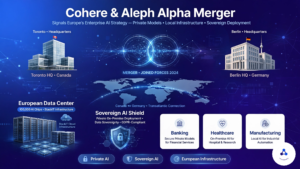
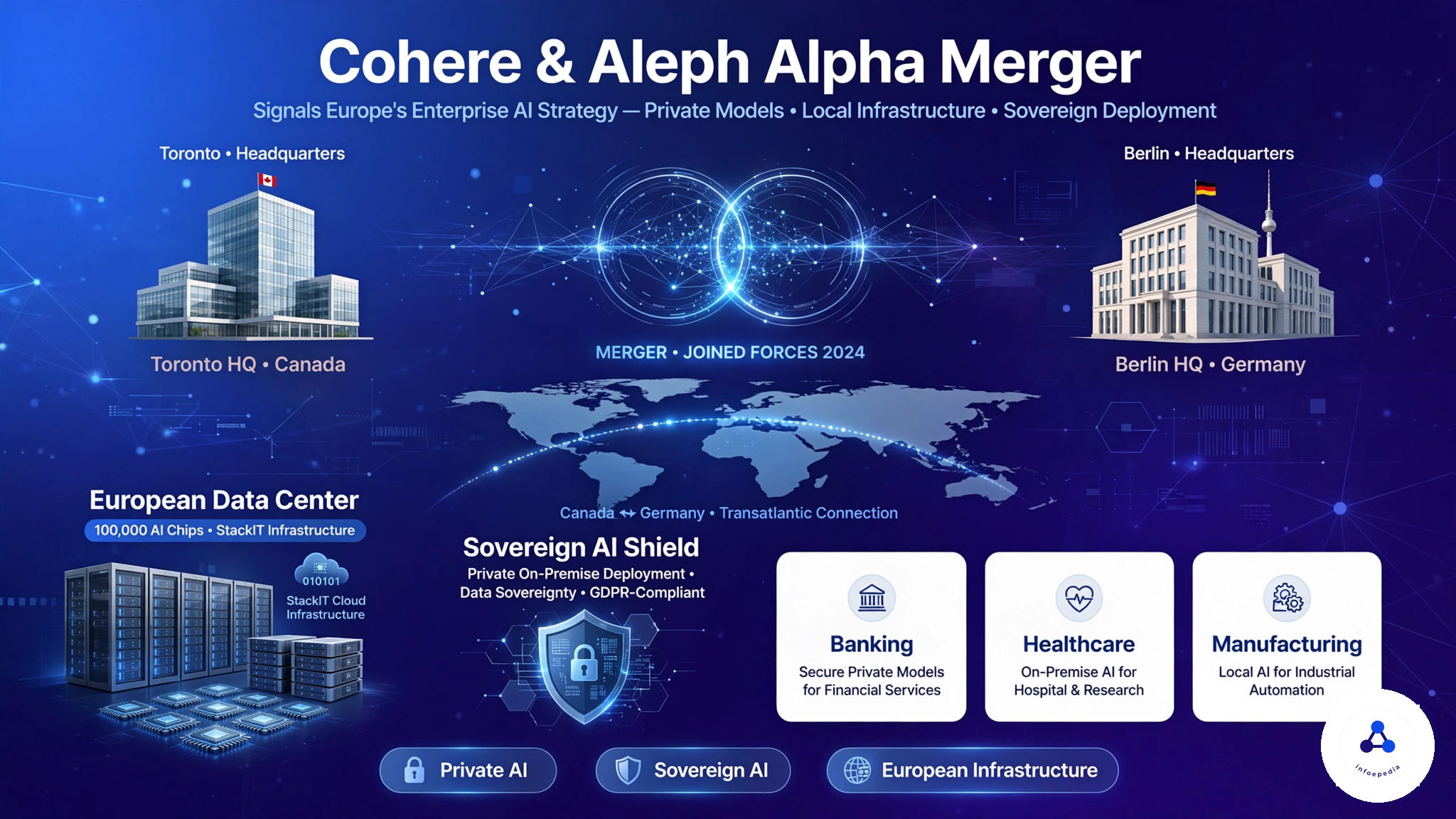
Cohere Aleph Alpha merger and Germany’s Aleph Alpha have finalized a merger agreement aimed at the enterprise AI market. The combined company will operate under the Cohere brand with dual headquarters in Toronto and Berlin, while Schwarz Group is investing €500 million and contributing cloud capacity through StackIT. The deal reflects a larger shift: enterprise buyers increasingly want AI that can run inside their own infrastructure and satisfy regional regulatory requirements.
What happened
Reuters reports that the merger, valued at roughly $20 billion when initially disclosed, is designed to combine Cohere’s enterprise-focused model business with Aleph Alpha’s integration expertise and European footprint. Cohere Aleph Alpha merger Heidelberg operation will remain focused on research, and its co-chief Ilhan Scheer will become Cohere’s chief operating officer.
The transaction is important because it is not simply a model-company merger. It combines models, integration capability, regulatory positioning, and infrastructure. StackIT is developing a German data center designed to host up to 100,000 AI chips, creating a potential deployment path for customers that need geographic control and tighter governance.
Why it matters
The enterprise AI market is moving from experimentation to procurement. Large organizations increasingly ask where models run, who can access data, how long data is retained, and whether AI systems can be deployed in controlled environments. In regulated sectors, the answer may matter more than a small difference in benchmark scores.
This creates room for providers that can deliver private, compliant, and customizable AI. Many customers do not want their most sensitive data sent to a public endpoint, especially when they need predictable latency, auditability, and legal clarity.
Technical and business analysis
Sovereign AI is often discussed as a geopolitical concept, but the practical issues are operational. Enterprises need deployment choices: dedicated cloud, virtual private infrastructure, on-premise environments, or hybrid arrangements. They also need policy controls, tenant isolation, identity management, logging, and data residency.
For agentic systems, infrastructure becomes even more important. Agents make many tool calls, maintain state, and access business systems. A company may accept a chatbot hosted externally, but hesitate to give an autonomous agent broad permissions unless it can control the runtime environment.
The merger also reflects the changing role of AI vendors. The market is rewarding companies that can integrate models into workflows, not just train them. Enterprise customers buy outcomes: document processing, secure search, software modernization, analytics, and automation.
Agentic AI implications
Sovereign deployment can make agentic AI more practical in regulated industries such as banking, healthcare, public services, and manufacturing. Agents can operate on private data while remaining within the organization’s security boundary. That supports use cases like internal research, compliance review, procurement analysis, and industrial troubleshooting.
Agentic Commerce implications
In commerce, local infrastructure can support secure product data, order systems, payment orchestration, and customer-service agents. Regional deployment can help brands and marketplaces satisfy data residency requirements while still offering personalized assistance. For cross-border commerce, sovereign infrastructure may become part of the trust stack.
Agentic Marketing implications
Marketing teams often work with sensitive customer and campaign data. Private AI can help with segmentation, content operations, forecasting, and sales enablement without exposing proprietary information. It can also support localized models and language capabilities for regional markets.
Practical business takeaways
Map data sensitivity before selecting a model provider. Separate “public experimentation” from “production autonomy.” Ask vendors about deployment options, audit logs, retention, private networking, model customization, and incident response. For agent projects, evaluate the entire stack: model, tools, identity, memory, storage, and observability.
Future outlook
The Cohere Aleph Alpha merger combination suggests that the next phase of enterprise AI competition will be fought on deployment, trust, and integration. Europe may not lead every frontier-model benchmark, but it can build strong positions in regulated, sovereign, and workflow-specific AI. The broader lesson is global: businesses will choose AI systems that fit their operating environment, not merely the most famous model.
FAQ
Why is the Cohere Aleph Alpha merger significant?
It combines enterprise models, integration capabilities, European positioning, and access to local infrastructure.
What is sovereign AI?
AI designed or deployed so that data, operations, and governance remain within a defined national or regional control boundary.
Why does sovereignty matter for agents?
Autonomous agents need access to sensitive systems, making control over runtime, identity, and data more important.
What should enterprises evaluate?
Deployment location, retention, auditability, permissions, latency, customization, and operational support.
Conclusion
The Cohere-Aleph Alpha merger is a signal that enterprise AI is becoming an infrastructure decision as much as a model decision. As agentic systems move into regulated and mission-critical workflows, local control, trusted integration, and predictable governance may become the features that win the market.