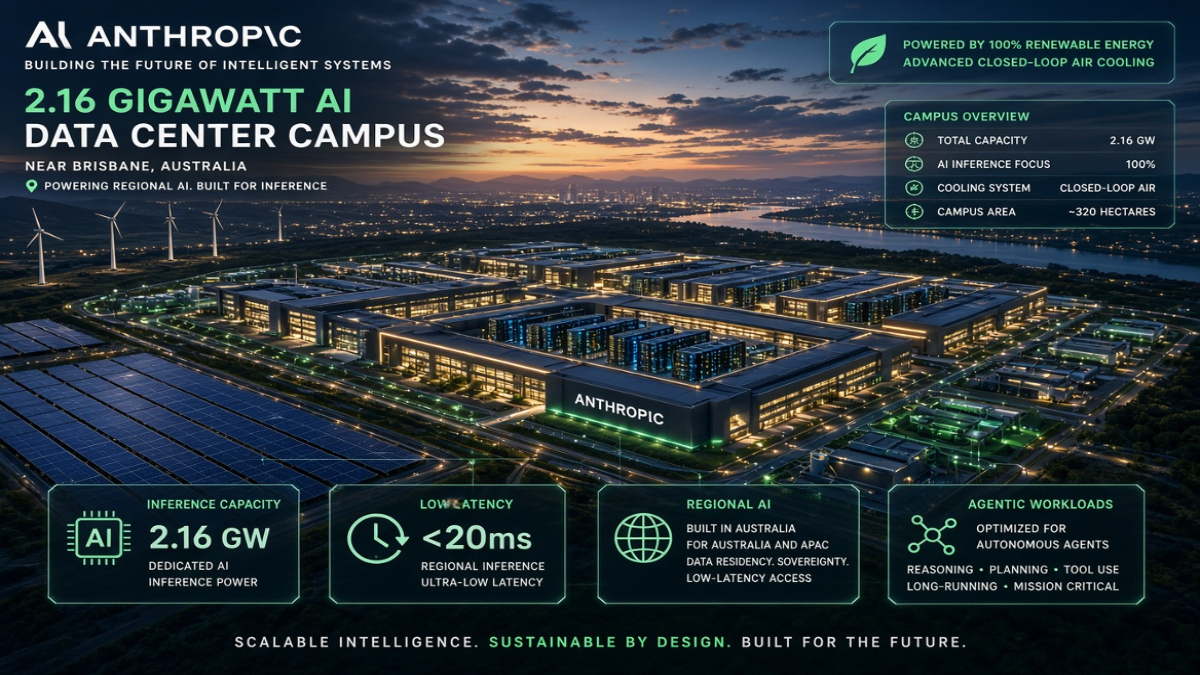
Anthropic Australia data center has signed its first data center lease agreement in Australia, securing a site with planned capacity of about 2.16 gigawatts near Brisbane. Reuters reports that the campus is expected to begin operations in 2027 and will focus on AI inference rather than training. The development shows how AI infrastructure is becoming a strategic business asset shaped by geography, energy, regulation, and customer latency.
What happened
The project is being developed by Singapore-based Zerra DC and is designed to use renewable energy and a closed-loop, air-cooled system intended to reduce water consumption. The site still requires approval from Australia’s Foreign Investment Review Board.
Anthropic’s choice to emphasize inference is significant. Training frontier models requires massive compute, but inference is the ongoing workload that serves users and agents every day. As AI products scale, inference capacity becomes the infrastructure layer that determines latency, availability, and cost.
Why it matters
The AI industry is moving beyond a simple race for model quality. Companies now need dependable compute close to customers and compliant with local rules. Enterprises in finance, healthcare, government, and commerce increasingly care about where data is processed, how quickly results are returned, and how much energy or water the system consumes.
Inference capacity is especially important for agentic AI. Agents make many model calls, use tools, check results, and often operate in loops. That means a single business task can require far more compute than a single chatbot response. Inference infrastructure must therefore support bursty workloads, predictable latency, and strong isolation.
Technical and business analysis
A large inference campus is not just a warehouse of chips. It requires networking, orchestration, storage, security, cooling, energy management, and scheduling systems. The quality of that infrastructure affects the user experience of every downstream AI product.
The Australian site also reflects the growing importance of sovereign and regional AI capacity. Countries want more control over how AI systems are deployed and regulated. For providers, local infrastructure can improve resilience, meet data residency expectations, and make it easier to serve regional customers.
The environmental design is another strategic signal. Data centers are under pressure to reduce water usage and prove that AI growth is compatible with sustainability goals. Closed-loop cooling and renewable energy do not eliminate all impacts, but they can improve the resource profile of inference at scale.
Agentic AI implications
Agentic systems need always-on infrastructure. A long-running agent may run for minutes, hours, or days. It may need scheduled execution, memory, tool calls, and rapid recovery. Regional inference capacity can make these workflows more responsive and reliable.
Agentic Commerce implications
In commerce, low-latency inference can improve product search, personalized recommendations, fraud detection, support, and dynamic merchandising. A shopper-facing agent must respond quickly enough to feel useful, especially during checkout or customer service interactions.
Agentic Marketing implications
For marketing, faster inference enables more frequent optimization. Agents can analyze performance signals, generate variations, adjust bids, and respond to market changes with less delay. The infrastructure layer becomes part of campaign performance.
Practical business takeaways
When evaluating AI vendors, ask where inference occurs, how data is isolated, what service levels are guaranteed, and how the provider handles regional compliance. Model quality should be evaluated together with latency, uptime, cost, and deployment geography. Businesses should also consider hybrid architectures that keep sensitive workloads closer to their own environment.
Future outlook
The AI infrastructure market is moving toward a distributed, regional model. The largest labs will continue building giant centralized campuses, but customer demand will also push capacity closer to users and regulated industries. Over time, the most competitive AI providers may be those that combine frontier models with efficient, resilient, and geographically intelligent inference networks.
FAQ
What did Anthropic announce?
Anthropic signed a lease for a large Australian data center campus with planned capacity of about 2.16 gigawatts.
Will the site train models?
The current plan emphasizes AI inference rather than model training.
Why is inference important?
Inference is the continuous compute used to serve users and run agents after models have been trained.
What does this mean for businesses?
It may improve regional latency, data residency options, and reliability for enterprise AI applications.
Is sustainability part of the story?
Yes. The project is designed around renewable energy and closed-loop cooling to reduce environmental impact.
Conclusion
Anthropic’s Australia deal illustrates a broader truth: the future of AI will be constrained and enabled by infrastructure. For agentic AI, Agentic Commerce, and Agentic Marketing, the ability to deliver fast, reliable, and compliant inference may matter almost as much as the model itself.