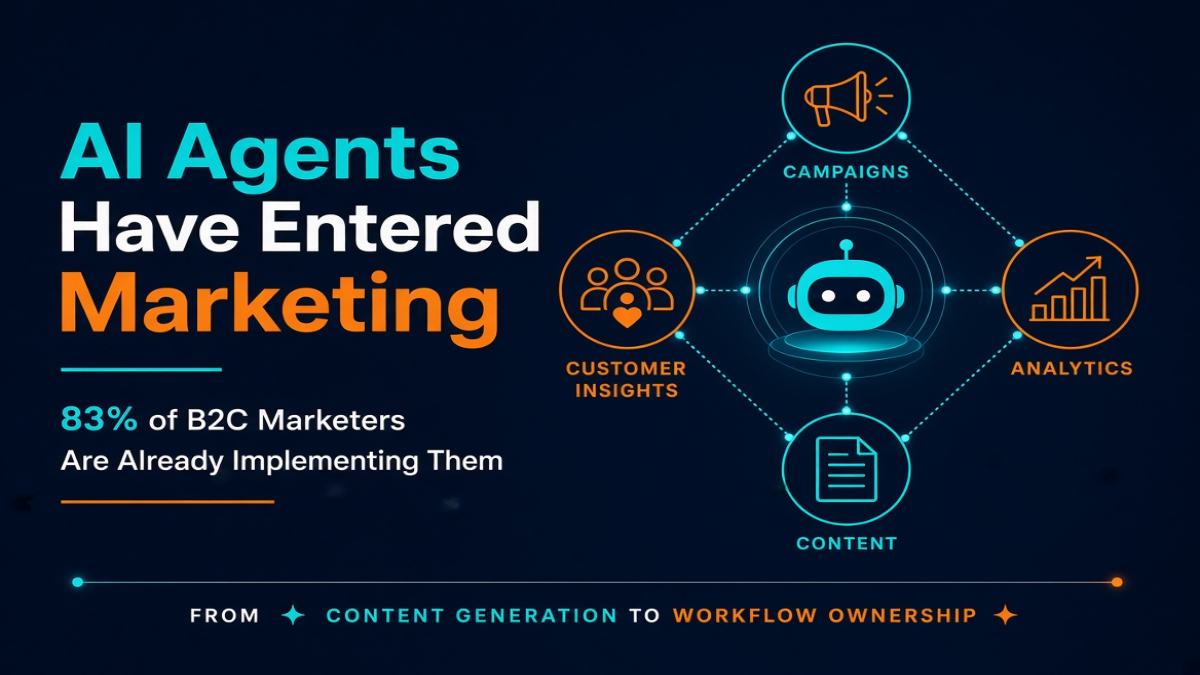
Agentic AI is no longer a future concept for agentic marketing departments. According to a September 8, 2026 analysis from Forrester, 83% of B2C marketing decision-makers report actively implementing agentic AI into their workflows, while 85% say the technology is delivering meaningful business value. The finding marks an important transition: AI agents are moving from experimentation into operational marketing. The difference between generative AI and agentic marketing is workflow ownership. A generative system can draft an advertisement, social post, email, or product description when asked. An agent can go further by monitoring performance, analyzing customer signals, identifying an opportunity, creating variants, launching an approved action, measuring the result, and adjusting the next step. In other words, the agent becomes part of the marketing operating system. Forrester points to use cases spanning customer insights, content creation, marketing operations, and campaign execution. That breadth matters because modern marketing is already a complex network of platforms. Teams work across CRM systems, advertising platforms, analytics tools, ecommerce stores, social channels, email systems, content management platforms, and customer-support databases. Agents can potentially connect these fragmented workflows. However, the report also highlights a crucial limitation: companies cannot simply deploy unlimited numbers of agents and expect unlimited productivity. Agents require implementation, maintenance, monitoring, governance, and human oversight. The strategic question is therefore not “Where can we add AI?” but “Which workflows should be redesigned around AI?”
This distinction is particularly important for agencies. A digital marketing agency can use agents to accelerate research, SEO analysis, competitor monitoring, reporting, creative testing, audience segmentation, and campaign operations. But clients will still expect accountability for outcomes. An agent-generated campaign that spends money incorrectly or damages brand reputation creates a business problem, not just a technical error. Agentic Marketing also changes measurement. If agents continuously optimize campaigns, traditional reporting cycles can become too slow. Businesses will need real-time or near-real-time monitoring of conversion rates, customer acquisition costs, return on ad spend, creative fatigue, inventory availability, and customer sentiment. The agent should have clear success metrics and boundaries. The relationship between Agentic Marketing and Agentic Commerce is also becoming tighter. A marketing agent may identify demand, while a commerce agent manages product availability, pricing, catalog data, customer service, and transactions. This creates a connected loop from discovery to purchase. For ecommerce businesses, the best AI architecture may eventually combine marketing, merchandising, customer service, and commerce agents rather than operating them as isolated systems.
SEO is changing as well. Marketers now need to think about whether AI systems can understand and recommend their brands. Clear product descriptions, authoritative company information, structured data, consistent entities, trustworthy reviews, and accessible content become important inputs for AI-driven discovery. This is where GEO, AIO, and AEO strategies increasingly intersect with traditional SEO. Practical business takeaways are straightforward. Start with high-volume, repeatable workflows. Give agents access only to the data and platforms they need. Define approval thresholds. Build evaluation dashboards. Track business outcomes. Keep humans involved in strategy, brand governance, legal review, and high-risk decisions. Companies should also avoid the “agent everywhere” trap. Ten poorly designed agents can create more operational complexity than one well-designed system. The better approach is to create a small number of specialized agents with clear responsibilities and strong orchestration. The future outlook is an always-on marketing organization where AI systems monitor signals continuously and humans focus on strategy, creativity, positioning, relationships, and judgment. Marketing teams will increasingly manage fleets of specialized agents rather than performing every repetitive operation manually.
FAQ:
1- What is Agentic Marketing?
Ans- It is the use of AI agents to plan, execute, monitor, and optimize marketing workflows.
2- Is it replacing marketers?
Ans- Not completely; human strategy and judgment remain essential.
3- What does Forrester report?
Ans- It says 83% of B2C marketing decision-makers are actively implementing agentic AI and 85% report meaningful value.
4- What should businesses automate first?
Ans- Repetitive, measurable workflows with clear inputs, outputs, and approval rules.
Conclusion: The marketing industry has crossed an important threshold. Agentic AI is becoming operational infrastructure, not merely a content-generation tool. Companies that redesign workflows around measurable agent performance will have an advantage over businesses that simply add AI features to old processes.