
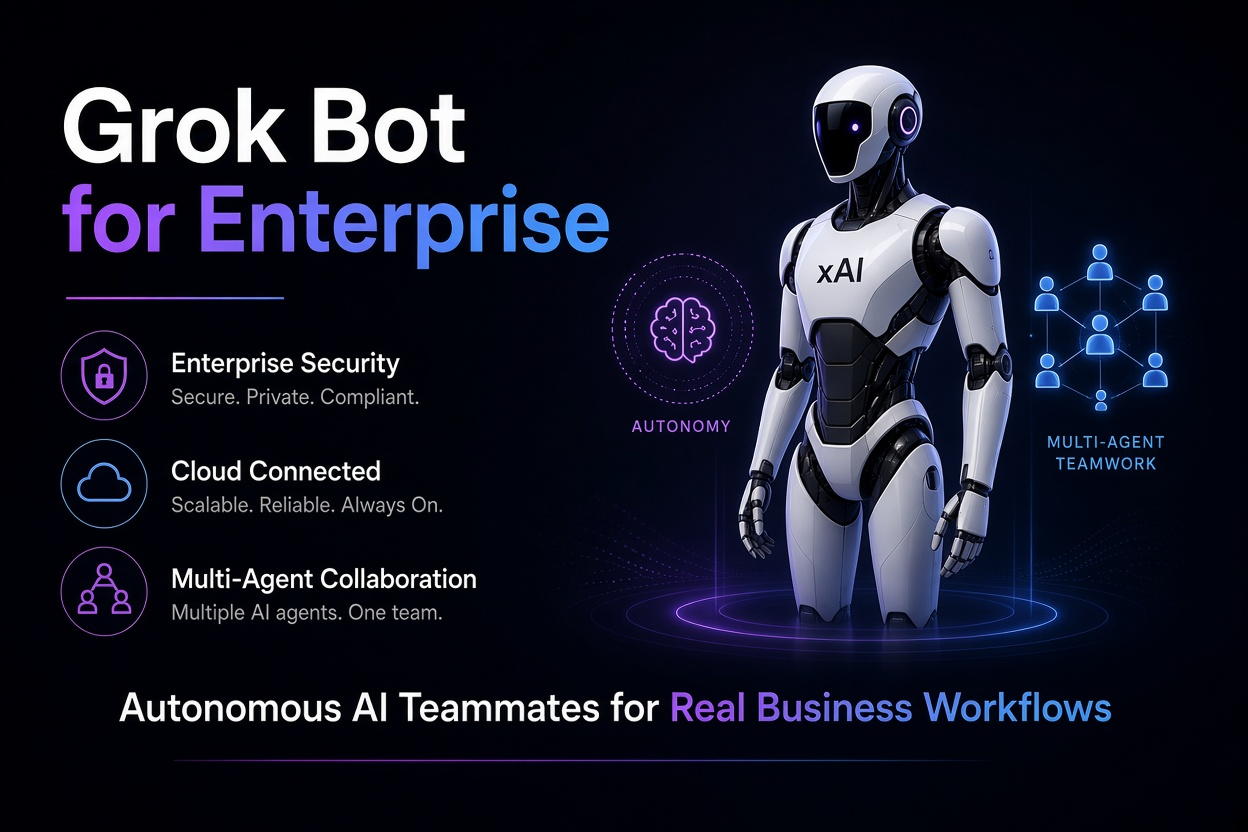
xAI is taking another step toward an agent-first enterprise model with the launch of Grok Bot for Enterprise, turning its vision of AI teammates into a product designed for organizational use. The announcement is significant because it moves the conversation beyond chatbots that answer questions and toward persistent AI workers that can accept a task, operate software, and return when the work is completed or when human judgment is required.
According to xAI, Grok Bot gives organizations AI teammates that can work autonomously around the clock inside the same tools employees already use. Each Bot operates on its own computer in the cloud and can use applications and websites in a way that resembles a human worker. The enterprise release adds controls for access, networking, and auditing, addressing one of the most important barriers to business adoption: organizations need agents to be useful, but they also need to know what those agents can access and what they did.
The eye-opening story is the shift from AI assistance to AI execution. Traditional generative AI is usually interaction-driven. A person asks a question, receives an answer, evaluates it, and then performs the next action. An agentic system changes that workflow. The user delegates a goal, the agent breaks the goal into steps, uses tools, maintains context, and completes work with fewer interventions. This can dramatically change how knowledge work is organized.
For sales teams, an agent could research prospects, update a CRM, prepare follow-ups, and surface decisions that require approval. For marketing teams, agents could monitor campaigns, collect performance data, prepare creative briefs, and coordinate repetitive workflows. For operations teams, agents could process routine requests, work across email and business applications, and escalate exceptions. The value is not simply faster text generation; it is the ability to connect reasoning with action.
xAI’s product direction also points toward multi-agent organizations. The company describes a model in which businesses can create multiple Bots for different jobs, with each one working independently. This suggests a future where an organization may manage a digital workforce made up of specialized agents rather than relying on one universal assistant. One agent could handle research, another sales operations, another customer support, and another engineering tasks, while humans remain responsible for strategy, approvals, and accountability.
This has major implications for Agentic Marketing. Marketing automation has traditionally depended on predefined workflows, triggers, and rules. Agentic marketing adds a reasoning layer that can adapt to changing information. Instead of merely sending an email when a condition is met, an agent can analyze a prospect, decide what information matters, select an appropriate action, execute it through connected tools, and report the result. That makes marketing operations more dynamic and potentially much more personalized.
Agentic Commerce could experience an even larger transformation. Commerce agents can eventually move from product discovery to comparison, purchase preparation, customer service, returns, and post-purchase engagement. The important competitive advantage will increasingly belong to companies whose systems are structured so agents can safely access product data, inventory, pricing, promotions, fulfillment information, and customer-service policies.
The enterprise launch also highlights the importance of governance. Autonomous systems need clear permissions, audit trails, network boundaries, human approval points, and policies for sensitive actions. The more capable an agent becomes, the more important these controls become. Enterprise AI is therefore becoming both an intelligence problem and an infrastructure-and-governance problem.
For businesses, the practical lesson is to start with workflows rather than vague AI experimentation. Identify repetitive processes that require judgment, connect the agent to the minimum necessary tools, establish approval checkpoints, measure outcomes, and expand only after reliability is demonstrated. The winning organizations will not simply deploy more AI; they will redesign workflows around what agents can reliably execute.
xAI’s enterprise Grok Bot is therefore another marker in the transition toward persistent, autonomous digital labor. The competitive question is shifting from ‘Which chatbot is smartest?’ to ‘Which agent can reliably complete valuable work inside my business?’ That is a much more consequential race, and it is likely to shape the next phase of enterprise software.