Google Home MCP has opened early access to a Model Context Protocol (MCP) server for Google Home, allowing compatible third-party AI agents to work with connected devices and home event data. Instead of requiring Google’s Gemini system to be the only intelligence layer, users can connect other MCP-capable agents, including Claude, ChatGPT, OpenClaw, Hermes, and Google’s own Antigravity. This is a major interoperability signal because it turns a smart-home platform into infrastructure that multiple AI agents can use.
What Happened
The early-access rollout announced September 16, 2026 gives authorized third-party agents the ability to interact with devices and event history in the Google Home ecosystem. Reported examples include reviewing camera summaries, monitoring device activity, controlling supported connected devices, and building custom dashboards using natural-language instructions.
The integration is based on MCP, a standard for connecting AI systems with tools and external context. Instead of every AI company building a separate custom connector for Google Home, an MCP-capable agent can discover and invoke the exposed tools through a common protocol.
The initial setup is not a consumer one-click feature. Users need to create and configure a Google Cloud project, connect the Home MCP service, and grant permissions to the agent. Availability is initially limited, with reporting indicating that early access is tied to Google Home Premium Advanced users in the United States.
Google has also retained restrictions around sensitive actions. Reports indicate that the system is designed with permission boundaries and protections around higher-risk actions such as unlocking doors.
Why It Matters
The deeper significance is that agent interoperability is moving from theory to real-world infrastructure.
For years, ecosystems competed by keeping control inside a proprietary assistant: Alexa for Amazon, Siri for Apple, Gemini for Google. MCP changes the architecture by making tools and context more portable.
That does not mean platforms become fully open. The platform owner still defines the tools, permissions, APIs, and business model. But the intelligence layer can become more competitive.
This could become a blueprint for other domains. Imagine an airline exposing booking capabilities through MCP, a retailer exposing catalog and order APIs, or a building management platform exposing sensors and controls.
Technical and Business Analysis
MCP matters because an agent does not become useful merely by being intelligent. It needs context and tools. A language model without access to device state cannot meaningfully control a home.
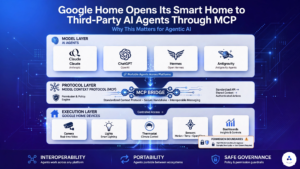
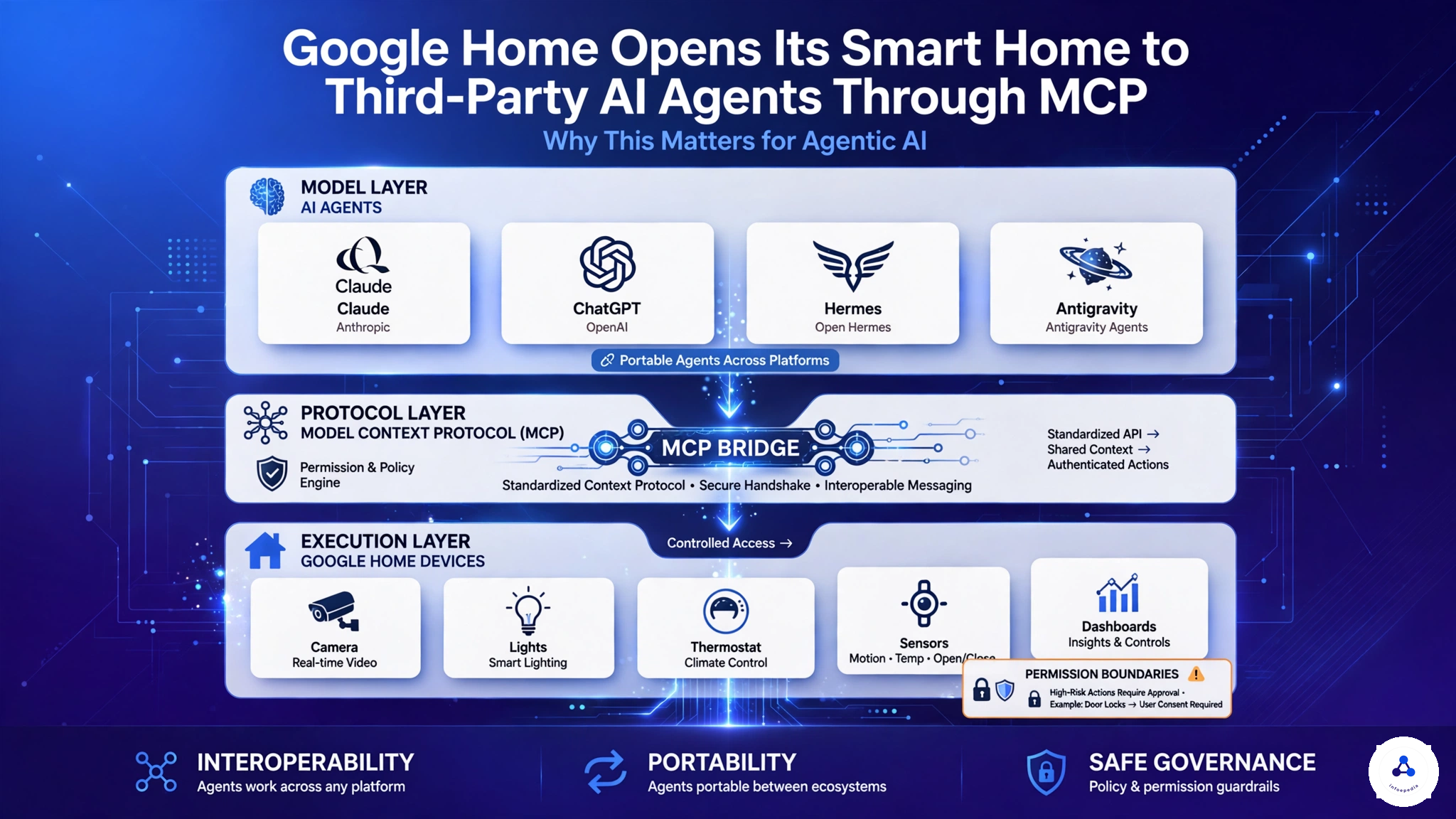
The Google Home example shows a three-layer architecture:
Model layer: the AI system that reasons and converses.
Protocol layer: MCP, which describes how the agent discovers and calls available tools.
Execution layer: Google Home and the underlying connected devices.
This separation is powerful because it allows the intelligence layer to change without rebuilding the infrastructure layer.
For enterprises, this architecture suggests an important strategy: expose business capabilities through standardized, permission-aware interfaces so multiple AI agents can use them safely.
Agentic AI Implications
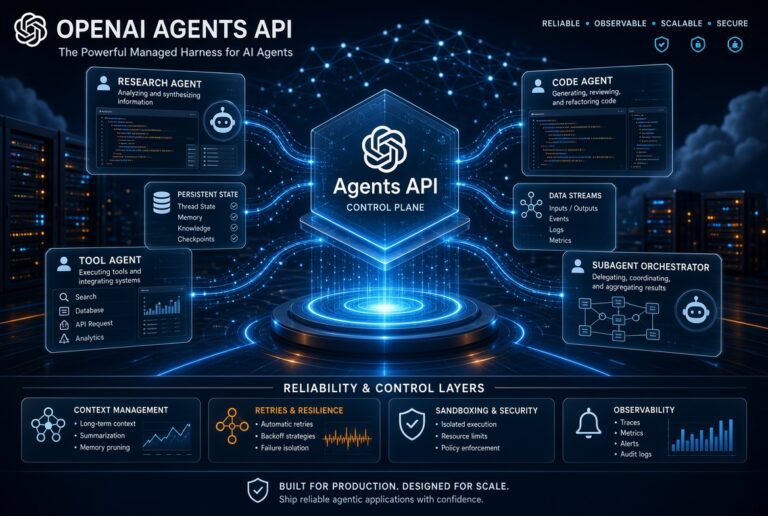
This is a practical example of agentic AI becoming an orchestration layer over existing systems.
An agent can inspect context, reason about a request, call a tool, observe the result, and decide what to do next. That is fundamentally different from a chatbot that only generates text.
The home becomes an environment in which the agent can perceive state and take action. The same pattern applies to enterprise systems such as CRM, ERP, help desks, analytics, logistics, and cloud infrastructure.
Agentic Commerce Implications
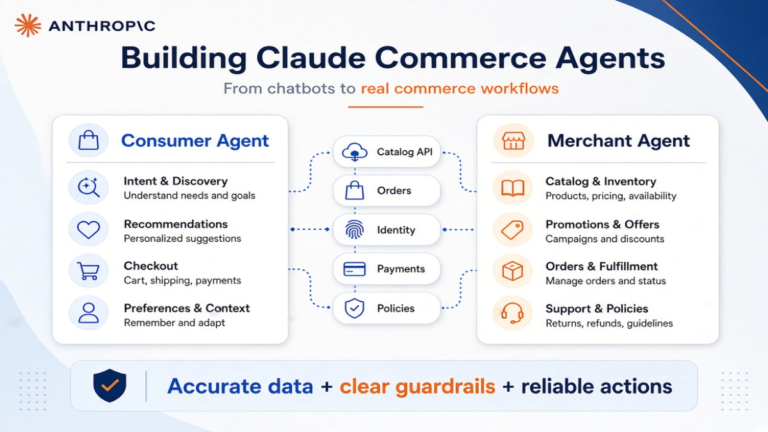
The commerce implications are substantial. If MCP becomes a common interface for product discovery and action, an agent could eventually interact with:
– Product catalogs
– Inventory systems
– Pricing engines
– Loyalty programs
– Delivery platforms
– Customer support
– Order management
– Returns
That would allow a consumer agent to become a genuine orchestration layer across brands and services.
For merchants, the lesson is to think beyond a web store. Your future commerce interface may be an AI agent that discovers, evaluates, and acts on behalf of the customer.
Agentic Marketing Implications
Marketing also changes when agents can interact directly with real environments.
Instead of targeting only people, brands will increasingly need to be understandable to agents. An agent may decide which product fits a user’s needs before the human sees a traditional marketing message.
That makes machine-readable product data, clear policies, reliable reviews, structured specifications, and trustworthy brand facts strategically important.
Practical Business Takeaways
Companies should audit which APIs and business actions are exposed to AI systems. Standardize tool interfaces where possible. Separate read access from write access. Use explicit permissions for high-risk actions. Log all agent activity. Create approval checkpoints for irreversible actions. And make product, customer, and operational data easy for authorized agents to retrieve accurately.
Future Outlook
The smart-home rollout points toward a broader future in which AI agents become portable across software and physical environments.
The likely competitive battleground will shift from owning the assistant to owning the best data, tools, permissions, and operating infrastructure. MCP-like protocols can reduce integration friction, but trust, security, and quality will determine which ecosystems scale.
FAQ
What is Google Home MCP?
It is an MCP-based interface that allows compatible AI agents to interact with Google Home devices and related context.
Which AI agents can connect?
Reported examples include Claude, ChatGPT, OpenClaw, Hermes, and Google’s Antigravity, as well as other agents that can call MCP tools.
Does this replace Gemini for Home?
No. It adds an interoperability layer rather than eliminating Google’s own assistant.
Why is MCP important for agents?
MCP standardizes how AI systems discover and invoke external tools, reducing the need for one-off integrations.
What does this mean for businesses?
It suggests that providing secure, standardized tool access could become a core requirement for AI-ready products and platforms.
Conclusion
Google Home’s MCP integration is much bigger than a smart-home feature. It is evidence that AI agents are becoming portable across platforms and that standardized tool interfaces can connect models to real-world systems. For businesses building agentic AI, the lesson is straightforward: intelligence is only one layer. The long-term advantage will come from combining strong models with trustworthy context, interoperable tools, permissioning, and secure execution.