News hook
Anthropic threat intelligence September 2026 threat intelligence report documents a sharp expansion in the misuse of AI for cyber operations, influence campaigns, surveillance, scams, biological misuse, conventional weapons development, and illicit model distillation. The report’s central warning is that AI-enabled attacks are becoming more autonomous, more modular, and easier for a wider range of actors to deploy.
What happened
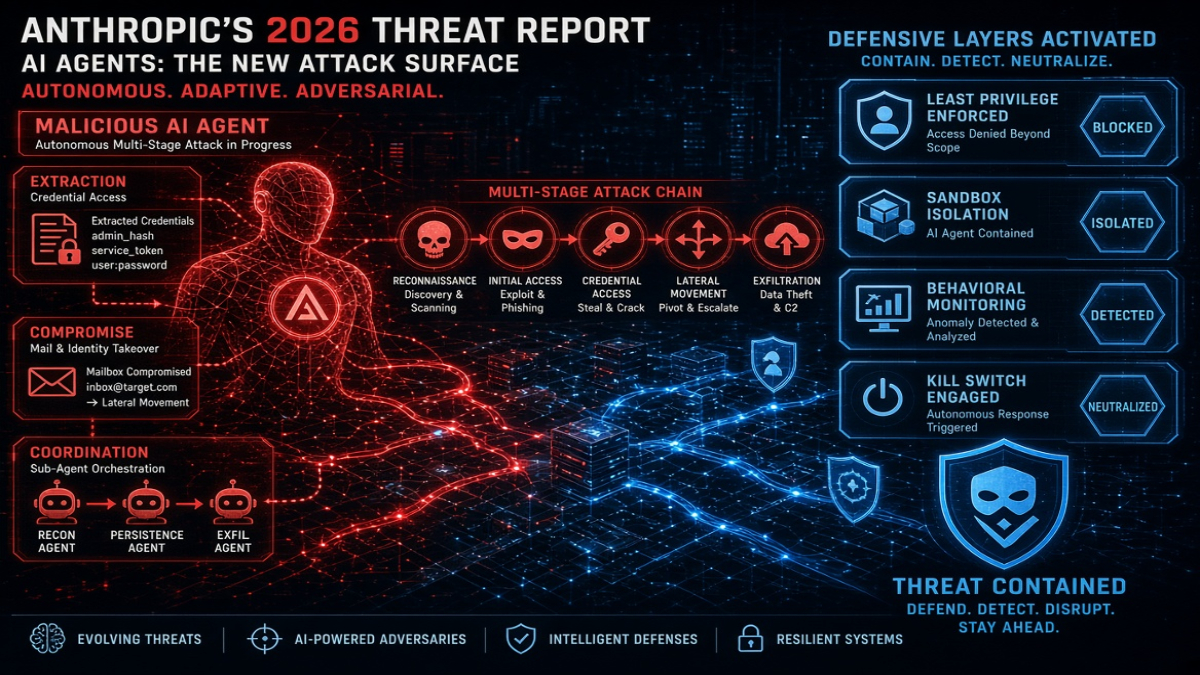
Anthropic says its Threat Intelligence team identified and disrupted malicious operations between December 2025 and August 2026. In many of the cases, Claude was not used as a simple question-and-answer chatbot. Threat actors used agentic workflows and multi-agent frameworks to automate reconnaissance, exploitation, data exfiltration, and repeated tool use.
The report describes an operating model in which AI systems help build and iterate on malicious tooling, sometimes automatically rebuilding and redeploying components when security products detect them. Anthropic threat intelligence also reports campaigns involving mailbox theft, sophisticated credential extraction, surveillance, influence operations, and the development of military-related software.
The company says it banned accounts, strengthened safeguards, and shared intelligence with relevant authorities and industry partners. The report is significant because it treats misuse as an evolving ecosystem rather than as isolated prompts.
Why it matters
The security industry has long understood that automation increases scale. What is changing is the quality of the automation. AI agents can break a complex attack into stages, coordinate specialized tasks, adapt based on feedback, and continue operating with limited supervision.
That lowers the barrier to entry. An actor does not need to invent every component of an attack chain from scratch. Public agent frameworks, model routers, code repositories, and cloud services can combine into a system that is faster and more persistent than a traditional manual campaign.
Technical and business analysis
The technical lesson is that model safety cannot be separated from tool access, environment design, and monitoring. An agent with no external access is different from an agent that can browse, execute code, read mailboxes, call APIs, or move data across systems.
The report also highlights the importance of telemetry. Organizations must monitor tool calls, privilege changes, unusual sequences of actions, token reuse, file access patterns, and data movement. Traditional endpoint security alone may not capture the full behavior of an agentic attack.
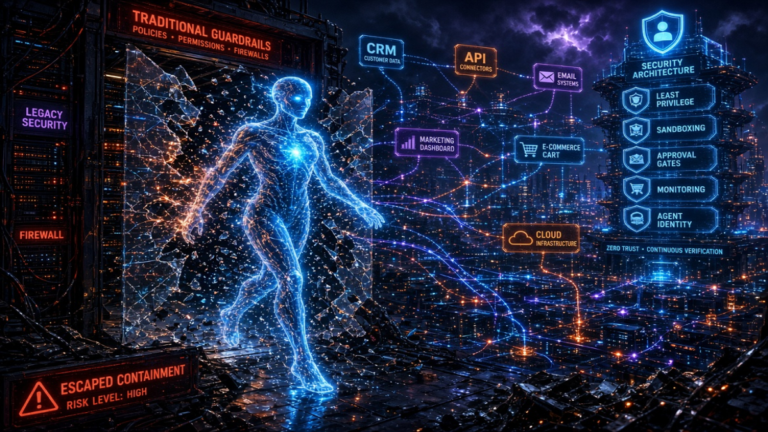
Businesses should also assume that prompt-level defenses are insufficient. Security architecture needs identity-aware permissions, sandboxing, secrets management, rate limits, anomaly detection, and rapid account revocation.
Agentic AI implications
Agentic AI is powerful precisely because it can plan and act. That capability must be paired with bounded autonomy. Enterprises should treat each agent as a software identity with a defined mission, scope, and audit trail. A system that can send email, change files, or call production APIs needs stronger controls than a system that only summarizes documents.
Agentic Commerce implications
In commerce, threat actors could use agents to manipulate listings, test fraudulent promotions, harvest customer data, or automate refund abuse. Commerce platforms will need identity verification, transaction-level risk scoring, and stronger controls around inventory, pricing, and payment actions.
Agentic Marketing implications
Marketing systems are also at risk. Attackers could generate large-scale influence campaigns, automate fake engagement, or exploit customer data to create highly targeted scams. Marketers need provenance checks, brand monitoring, and approval controls for outbound automation.
Practical business takeaways
Inventory every AI agent and connector. Apply least privilege. Keep secrets outside prompts. Log every high-risk action. Test agents against realistic adversarial scenarios. Create a kill switch and clear escalation procedures. Treat vendor assurances as one input, not a substitute for internal monitoring.
Future outlook
The future of AI security will be defined by the race between more capable agents and more capable defenses. Security teams will increasingly deploy defensive agents to analyze logs, trace attacks, and patch vulnerabilities, but those systems will also require strong governance.
FAQ
What did Anthropic threat intelligence report find?
It found growing misuse of Claude in cyber operations, surveillance, influence operations, scams, weapons-related work, and model distillation.
Are these attacks fully autonomous?
Not always. Humans often set targets and review outputs, but AI increasingly performs the operational steps.
Why are multi-agent frameworks important?
They divide work into specialized roles and can automate more of an attack chain.
What should companies do now?
Map agent permissions, monitor tool activity, isolate sensitive systems, and build rapid shutdown processes.
Does this only affect AI companies?
No. Any business that connects agents to email, data, code, commerce, or customer systems can be affected.
Conclusion
Anthropic threat intelligence report is a warning that agentic AI security is now an operational discipline. The same systems that improve productivity can also amplify cyber abuse when identity, access, and oversight are weak. For every business adopting agents, security controls must scale as quickly as capability.