News hook
OpenAI Agents API has introduced the Agents API in public beta, giving developers access to the same style of managed harness and infrastructure that powers Codex. The announcement matters because it shifts the center of gravity in enterprise AI from short chat sessions to persistent cloud agents that can keep context, use tools, coordinate subagents, work with files, run code, and continue tasks over long periods.
What happened
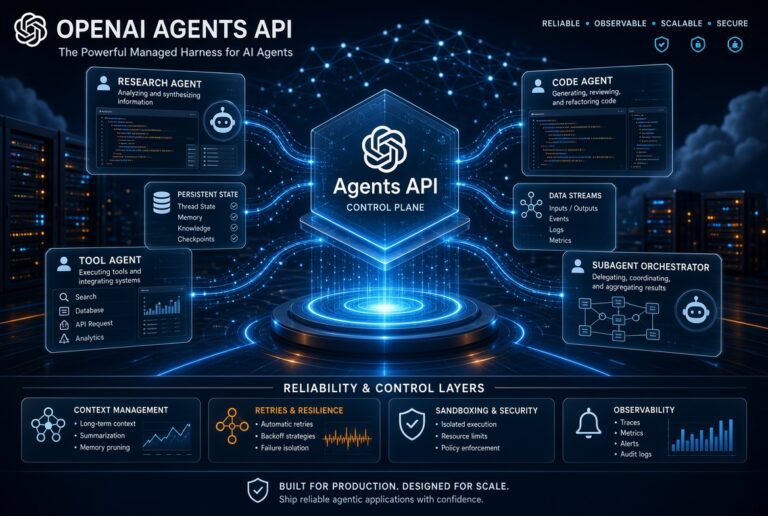
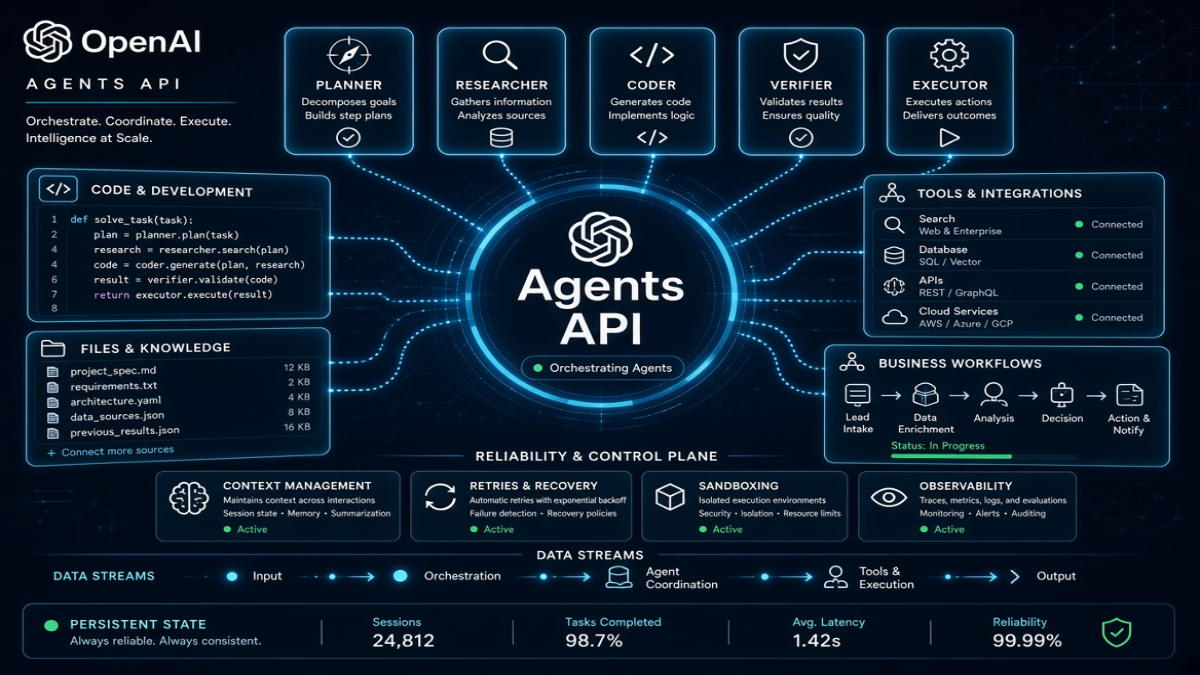
OpenAI says the Agents API is designed to help developers build and run cloud agents through a managed environment. The system is built around a harness that manages context, tool use, subagent coordination, files, code execution, and intermediate results. In practical terms, the API is aimed at workflows where the AI must plan, act, verify, recover from failures, and return with a completed result rather than simply produce a one-shot answer.
OpenAI’s public beta positioning also signals that the company is productizing the operational layer around agents. The model remains important, but the differentiator is increasingly the system that surrounds it: execution environments, state management, tool permissions, observability, and reliable handoffs between specialized agents.
Why it matters
This is a major development for agentic AI because most real business processes are not single prompts. They include data gathering, validation, approval, execution, exception handling, and reporting. A marketing campaign may require research, audience segmentation, content generation, compliance review, publishing, analytics, and optimization. A commerce workflow may require product discovery, comparison, inventory checks, pricing, payment authorization, order creation, and post-purchase service.
The Agents API makes those workflows easier to package as software. Instead of building every layer from scratch, teams can use managed infrastructure and spend more time on business rules, permissions, and measurable outcomes.
Technical and business analysis
The key technical idea is the agent harness. A harness gives a model a controlled operating environment. It can maintain context, call tools, launch subagents for specialized tasks, persist intermediate work, and return to the workflow after delays or failures. This is closer to distributed systems engineering than to traditional chatbot development.
That changes the economics of deployment. Businesses can move from expensive manual orchestration to reusable agent patterns. One agent can act as a planner, another as a researcher, another as a verifier, and another as an executor. The system can also enforce checkpoints so that sensitive actions require human approval.
Agentic AI implications
The biggest implication is that agentic AI is becoming an infrastructure category. The winning platforms will not be defined only by model intelligence. They will be defined by reliability, state, tool access, memory, observability, evaluation, and safety controls. For enterprises, this means agent design should begin with workflows and controls, not with a generic “AI assistant” label.
Agentic Commerce implications
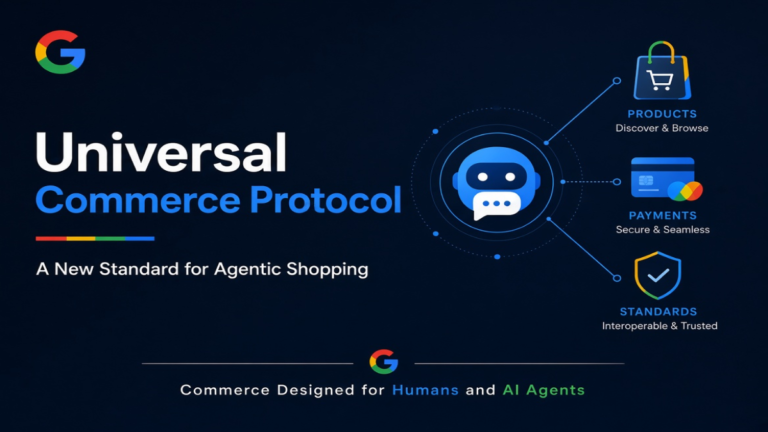
In Agentic Commerce, an OpenAI-powered cloud agent could search catalogs, compare products, identify the right offer, verify policy constraints, calculate delivery options, and prepare checkout. The commercial opportunity is enormous, but the controls are equally important. Agents need bounded authority over discounts, refunds, customer data, payment initiation, and supplier systems.
Agentic Marketing implications
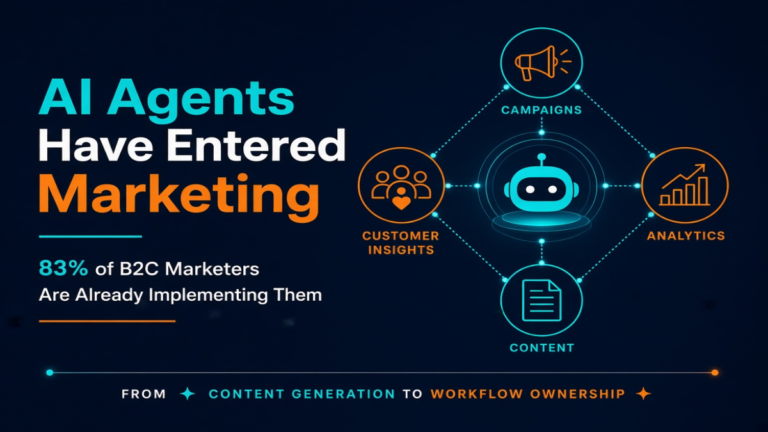
For Agentic Marketing, long-running agents can monitor campaign performance, detect anomalies, propose creative variations, test audience segments, and trigger approved changes. The important shift is from content generation to closed-loop optimization. Marketing teams become supervisors of systems that learn from live signals and continuously improve execution.
Practical business takeaways
Businesses should start with one workflow that is repetitive, measurable, and safe to automate. Map the tools, data sources, approval points, and failure modes. Set least-privilege permissions. Measure completion rate, human intervention, cycle time, error rate, and cost per task. Build rollback paths before giving an agent access to production systems.
Future outlook
The Agents API points toward a future in which cloud agents become a standard application layer. Over time, businesses may buy agent capabilities the way they buy databases, identity systems, or workflow engines today. The most valuable agents will not be the most talkative. They will be the ones that consistently complete real work with clear accountability.
FAQ
What is OpenAI’s Agents API?
It is a public-beta platform for building and running cloud agents with managed context, tools, files, code execution, and subagent coordination.
How is it different from a chatbot?
A chatbot mainly responds in a conversation. An agent can plan, use tools, perform actions, manage state, and continue work across longer workflows.
Why are subagents important?
Subagents let teams divide complex work into specialized roles such as research, verification, analysis, and execution.
Is the Agents API useful for e-commerce?
Yes. It can support product discovery, comparison, customer service, order workflows, and other commerce tasks when connected to approved systems.
What should companies do first?
Choose one measurable workflow, define permissions and approval checkpoints, then test reliability before expanding.
Conclusion
OpenAI’s Agents API is more than another developer endpoint. It is a signal that the next phase of enterprise AI will be built around persistent, tool-using, monitored agents. For Agentic AI, Agentic Commerce, and Agentic Marketing, the competitive advantage will come from turning these agents into dependable operating capability.