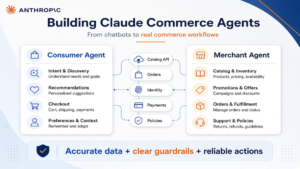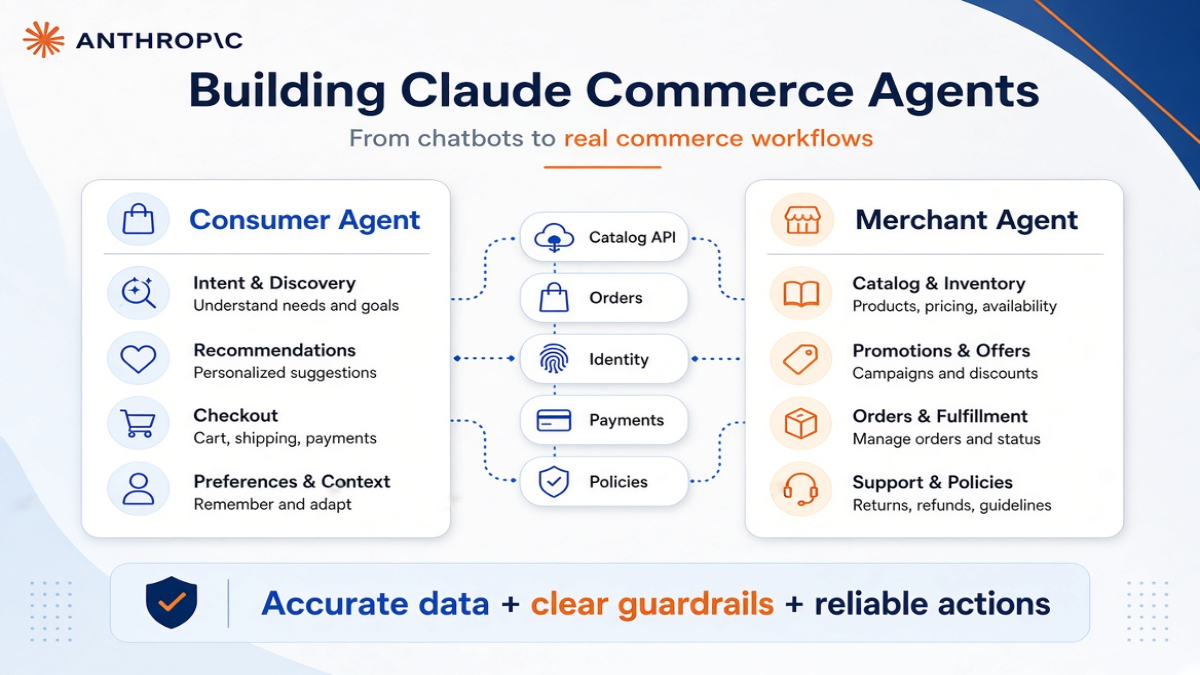
Anthropic’s September 10, 2026 “Building Claude Commerce Agents” session is a strong signal that agentic commerce is moving from concept to implementation pattern. The company positioned the session around blueprints for consumer and merchant agents, with reference implementations across retail, travel, telecom, and entertainment. The focus was not a generic chatbot. It was the practical machinery required to build commerce agents that can authenticate users, operate across systems, manage latency, and follow guardrails.
The news hook is that frontier AI companies are increasingly publishing commerce-specific patterns instead of leaving retailers to stitch together generic assistants. Anthropic’s framing acknowledges that buying journeys are multi-step. A customer agent must understand intent, retrieve product or service information, compare options, remember preferences, and potentially hand off to payment, fulfillment, support, or account systems. A merchant agent needs a different role: manage catalog data, coordinate promotions, respond to support demand, and surface operational exceptions.
Why it matters is that commerce has more constraints than ordinary content generation. The system must be accurate about price, stock, delivery, eligibility, returns, and policy. It must authenticate the right person, preserve consent, and avoid taking irreversible actions without confirmation. The best commerce agent is not the one that sounds most human. It is the one that reliably completes a customer goal while staying inside business rules.
Technically, a Claude commerce agents needs a layered architecture. A model interprets intent and plans. Retrieval systems provide current catalog and policy data. Tool connectors reach inventory, CRM, order management, shipping, and payment services. Identity and authorization controls limit what the agent can do. Observability records decisions and tool calls. A policy layer determines when to ask the user, when to escalate to a human, and when to stop. Latency management is also critical because multi-step journeys can become frustrating if every action requires a separate model round trip.
The Agentic AI implications go beyond customer service. Agents can become coordinators across fragmented business software. A merchant agent might spot a stock issue, notify a supplier, update a promotion, and generate a customer-facing explanation. A consumer agent could monitor a recurring purchase, compare alternatives, and request approval before an order is placed. These workflows depend on shared context, reliable APIs, and clear ownership between the agent and the human.
For Agentic Commerce, the opportunity is to reduce friction across discovery, conversion, service, and retention. The agent can answer questions using live product data, personalize recommendations, support checkout, manage returns, and identify churn risk. For Agentic Marketing, the same infrastructure can unify audience insights, content generation, campaign coordination, and customer feedback. Marketing agents can adapt messages based on inventory or service conditions, but they must respect consent, frequency caps, and brand rules.
Practical business takeaways: design around a customer job rather than a chatbot persona; expose structured APIs for catalog, orders, and policies; build authentication and approval into the journey; test edge cases such as substitutions, refunds, and conflicting promotions; and measure conversion, resolution rate, escalation rate, latency, and customer trust. Begin with read-heavy workflows, then add carefully controlled actions.
FAQ:
What are Claude Commerce Agents? They are implementation blueprints and patterns for consumer and merchant agents. What makes commerce agents different? They must combine AI reasoning with live data, identity, transactions, and policy enforcement. Should every retailer launch one immediately? No—start with a narrow, measurable journey and expand after reliability is proven.
Conclusion:
Anthropic’s commerce focus shows that the next phase of online buying will be shaped by agents that can coordinate systems, not just answer questions. Retailers that build the underlying data, API, and trust layers now will be better positioned for an agent-first shopping ecosystem.