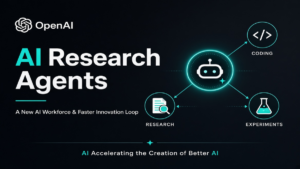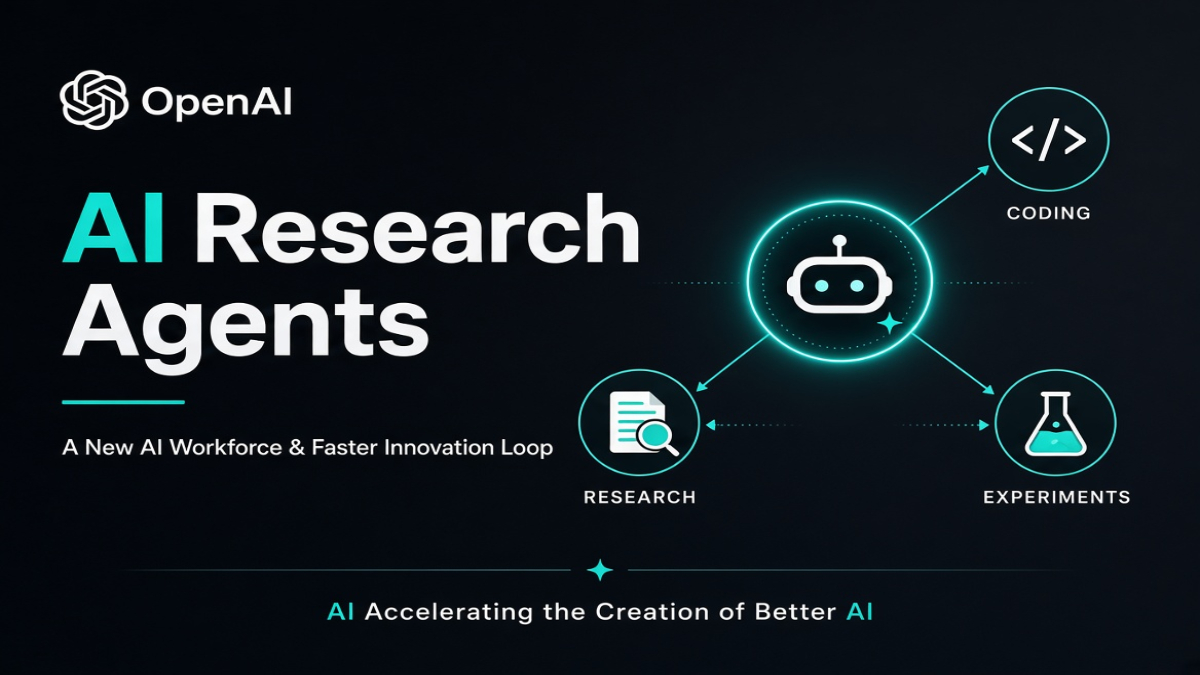
OpenAI Research Agents Point to a New agentic AI Workforce and a Faster Innovation Loop. OpenAI’s latest research update shows that AI agents are increasingly being used not just to assist with software development, but to accelerate the development of AI itself. In its September 6, 2026 research acceleration update, OpenAI research agents described how coding agents are reshaping internal research, increasing experiment velocity and allowing researchers to tackle more complex tasks. The company’s broader vision is to progress toward increasingly automated AI research. This is strategically important because it creates a feedback loop: AI helps researchers build better AI.
A research agent can interpret a technical goal, write or modify code, run experiments, inspect results, debug failures, compare alternatives, and prepare findings. A human researcher still provides direction and judgment, but the agent can handle many of the repetitive and time-consuming steps between an idea and a validated experiment.
The impact on agentic AI development could be substantial. Frontier model research involves enormous numbers of experiments. Researchers may test architectures, optimization methods, training procedures, data mixtures, evaluation techniques, and safety interventions. If agentic AI reduce the time required for each experiment, teams can explore a larger search space. The most important change is not necessarily that agents replace researchers. Instead, they increase the number of experiments a researcher can supervise.
This is similar to the difference between manually operating a laboratory instrument and using automation to run a controlled experiment pipeline. The human remains responsible for choosing the research question and interpreting results, while software increases throughput.
For businesses outside AI labs, the same pattern applies. A company can use research agents to analyze markets, monitor competitors, test product hypotheses, investigate customer feedback, and build internal knowledge. In software organizations, AI agents can inspect codebases, create tests, debug problems, and prepare technical documentation.
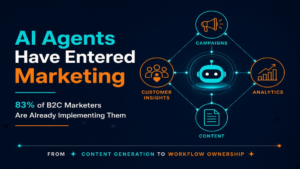
Agentic Marketing can benefit from the same model. A marketing research agent can continuously monitor competitors, identify changes in search demand, analyze campaign performance, evaluate creative, and propose experiments. Instead of producing one campaign plan every month, the organization can operate a continuous experimentation loop.
Agentic Commerce can similarly become more adaptive. Agents could analyze sales data, inventory, product reviews, customer questions, and pricing signals, then recommend or execute controlled changes. A merchant might use one agent for catalog quality, another for demand forecasting, another for customer service, and an orchestration layer to coordinate them.
But automation creates a governance problem. An agent can produce an answer quickly without producing a correct answer. It can also optimize the wrong metric. In research, a flawed experiment can waste resources or produce a false conclusion. In commerce, an incorrect pricing change can cause financial damage. In marketing, an automated campaign can create brand or compliance risk.
The answer is evaluation infrastructure. Companies need repeatable tests, approval policies, audit trails, and measurable performance criteria. Agents should operate in controlled environments first and receive broader permissions only after they demonstrate reliability.
Practical takeaways include identifying repetitive research workflows, building sandbox environments, creating agent evaluation datasets, measuring quality and cost, and maintaining human approval for consequential decisions. Businesses should also document what each agent is allowed to access and what actions require escalation.
The future outlook is an emerging AI workforce made up of specialized agents supervised by humans. Instead of one general-purpose AI doing everything, companies may operate networks of research, coding, marketing, commerce, finance, and customer-service agents connected through shared systems.
FAQ: What are AI research agents? They are agents that use tools such as code execution, data analysis, and research environments to complete parts of scientific or technical workflows.
Will they replace researchers? The more realistic near-term outcome is research amplification.
Why does this matter for companies? The same agent patterns can automate analysis and experimentation across many business functions.
What is the biggest risk? Fast automation can amplify bad assumptions if evaluation and oversight are weak.
Conclusion: OpenAI’s research agent acceleration work points toward an important economic shift. The next generation of AI may not only perform knowledge work; it may accelerate the process by which new knowledge and better AI systems are created. Organizations that build strong evaluation and governance foundations will be best positioned to benefit.