
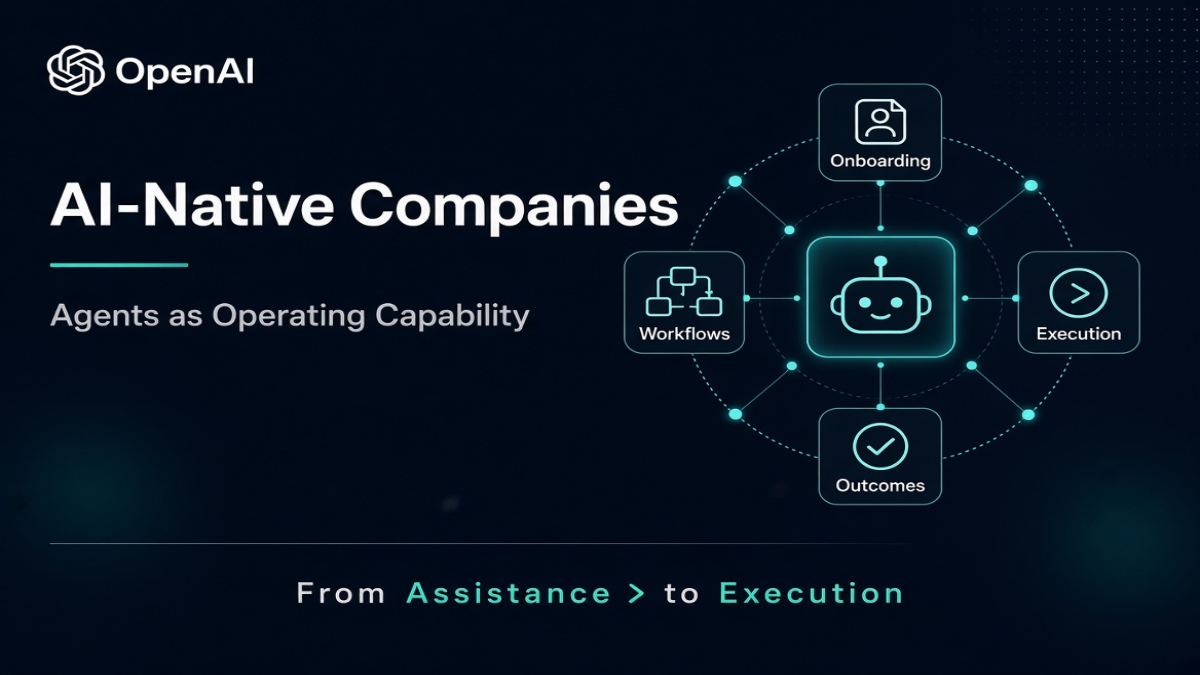
OpenAI is highlighting a major change in enterprise AI adoption: leading companies are moving from using AI as an assistant toward embedding agents directly into workflows. In a new analysis of AI-native companies, OpenAI describes how organizations such as Basis, Clay, and Exa Labs are using agents for onboarding, account management, developer integrations, and other operational processes.
The announcement provides an important lens for understanding where enterprise AI is heading. The first phase of generative AI adoption was dominated by individual productivity. Employees used AI to draft emails, summarize documents, brainstorm ideas, write code, and answer questions. The next phase is about operational capability: systems that can execute multi-step work and become part of the company’s operating model.
OpenAI’s latest Enterprise Signals data illustrates the widening gap between organizations that use AI heavily and those that use it lightly. OpenAI reports that frontier firms, defined as organizations in the top 10% of AI usage, generate 8.3 times as many output tokens per active user as typical firms, compared with 2.6 times in January. The precise metric should not be interpreted as a direct measure of business value, but it does show how quickly intensive AI usage is expanding among leading organizations.
The more important idea is workflow redesign. An agent becomes valuable when it is connected to the information, tools, and permissions required to complete a business process. Consider customer onboarding. A traditional process might involve a customer success manager collecting information, checking systems, sending emails, updating records, and coordinating internal teams. An agent can potentially orchestrate many of those steps, leaving the employee to focus on exceptions and relationship management.
This changes the role of the employee. Instead of performing every step, the human becomes a supervisor, decision maker, and quality controller. The result is not necessarily fewer people; in many cases, it can mean more leverage per employee. A small team can potentially manage a much larger volume of work when agents handle repetitive execution.
Agentic Marketing is a natural extension of this model. Marketing organizations contain dozens of workflows that cross tools: research, content production, campaign setup, CRM updates, analytics, lead qualification, reporting, and customer segmentation. An agent can connect these systems and execute processes that previously required manual coordination. The opportunity is to build a marketing operating system where agents continuously monitor signals and recommend or execute actions within defined guardrails.
Agentic Commerce is even more workflow-dependent. Commerce includes catalog management, product discovery, pricing, promotions, customer support, order processing, returns, and retention. An agent can potentially coordinate these processes across multiple platforms. The competitive advantage will therefore shift toward companies with structured, accessible data and systems that agents can safely operate.
There is also a lesson for AI implementation strategy. Companies should not start by asking, ‘Where can we add a chatbot?’ Instead, they should ask, ‘Which workflow is expensive, repetitive, slow, or difficult to scale?’ Then they can determine whether an agent can take responsibility for part of that process.
Reliability becomes critical at this stage. An AI-generated paragraph can be corrected by a human in seconds. An autonomous agent that changes a CRM record, sends a customer message, modifies pricing, or executes a transaction can create much larger consequences. That means agent deployments require permissions, auditability, evaluation, monitoring, approval checkpoints, and rollback mechanisms.
The OpenAI examples also point toward a new organizational metric: not simply how many employees use AI, but how much meaningful work is delegated to AI systems and completed successfully. Companies will need to measure task completion rates, human intervention, error rates, cycle time, cost per completed workflow, and business outcomes.
For technology leaders, the message is straightforward. AI adoption is becoming less about distributing a general-purpose assistant and more about building an AI-native operating layer. The companies that gain the most may be those that redesign their processes around agents instead of adding AI on top of old workflows.
The broader shift is from assistance to execution. Once agents can understand context, use tools, maintain state, and operate reliably over longer horizons, AI becomes part of the company’s operating capability. OpenAI’s latest enterprise examples suggest that this transition is already underway, and businesses that begin redesigning workflows now may be better positioned for the next stage of AI-driven productivity.