NVIDIA AI Energy Management Alliance, Google, and Emerald AI have launched the AI Energy Management Alliance (AEMA), a coalition focused on making AI data centers more flexible in how they consume electricity. Announced September 16, 2026, the initiative targets one of the biggest physical constraints on the AI boom: power availability.
The message is simple but strategically important. Scaling AI agents requires more compute, more inference, and more data-center capacity. But GPUs cannot run without electricity, and electricity infrastructure often takes years to expand.
What Happened
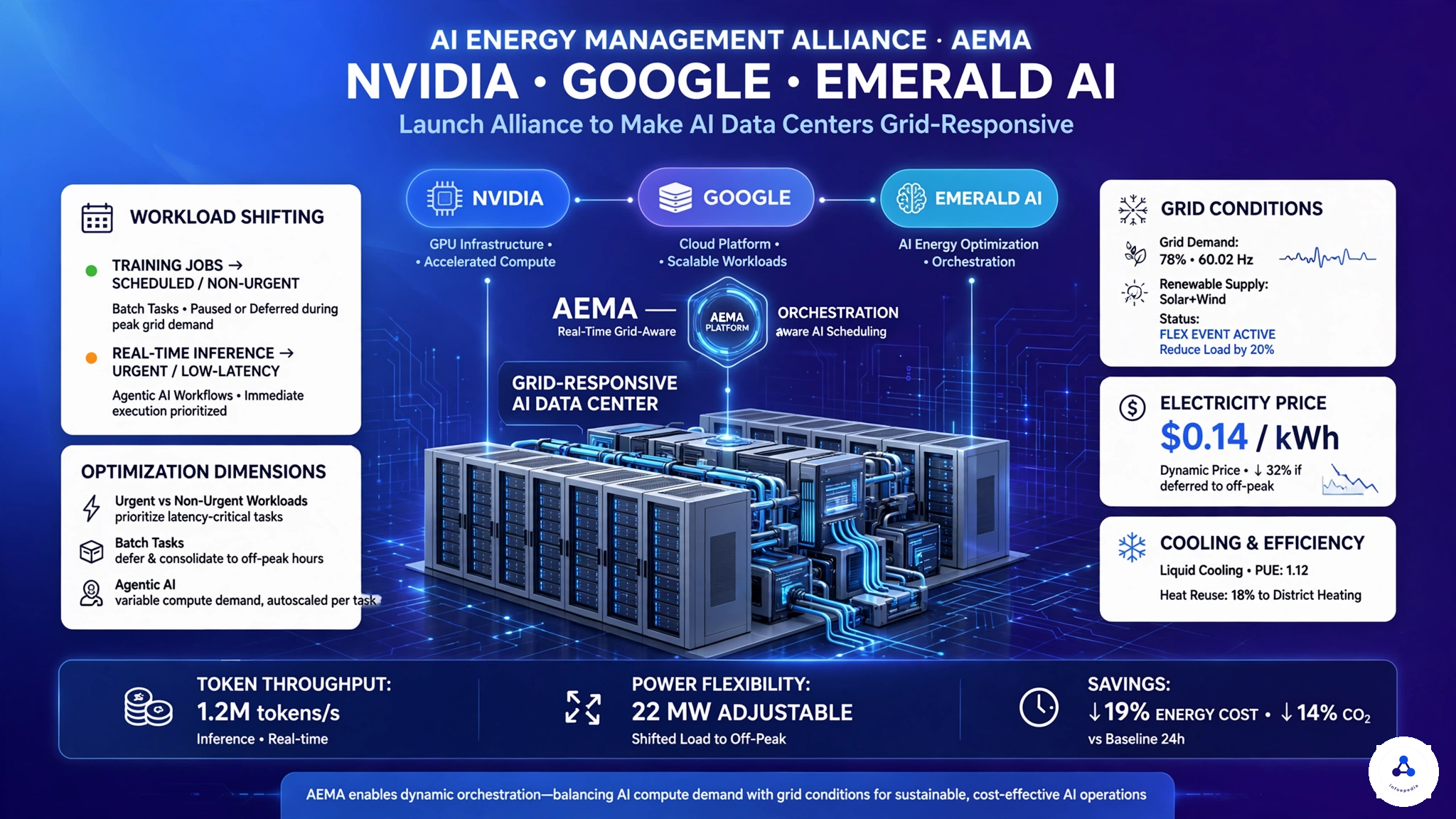
The alliance brings together companies across the AI and power ecosystem to develop ways for data centers to dynamically adjust power consumption in response to grid conditions.
NVIDIA says flexible data centers can help accelerate new AI infrastructure connections while improving grid reliability and supporting energy affordability. The goal is to treat AI facilities not only as large electricity consumers, but also as controllable resources that can adapt to changing grid conditions.
The founding members are joined by partners from AI, semiconductors, utilities, power generation, and data-center operations. NVIDIA describes the initiative as a way to unlock more usable capacity from existing power infrastructure while AI demand continues to grow.
Why It Matters
AI infrastructure discussions often focus on chips, networking, memory, cooling, and data centers. Increasingly, the bottleneck is becoming the electricity system that connects all of them.
This is especially relevant for agentic AI. An ordinary chatbot request may trigger one or two model calls. An autonomous agent can execute a workflow with repeated reasoning loops, tool calls, retrieval, verification, and sub-agents. The compute demand becomes more variable and potentially more intense.
A data center designed for agentic workloads must therefore optimize not only for peak throughput but also for cost, utilization, latency, and power flexibility.
Technical and Business Analysis
A flexible AI data center can potentially respond to grid conditions by shifting workloads, using stored energy, reducing non-urgent compute, or coordinating its demand with available power.
For AI infrastructure operators, this creates a new optimization problem. Instead of maximizing compute continuously, the system can optimize across several dimensions:
– Token throughput
– Workload priority
– Latency requirements
– Electricity price
– Grid conditions
– Cooling constraints
– Available generation and storage
Not every workload is equally urgent. Training jobs can often be scheduled differently from low-latency inference. Some batch tasks can move in time or location. Some agent evaluations can be deferred. A smart AI factory can therefore treat compute as a flexible demand resource.
Agentic AI Implications
Agentic AI makes infrastructure efficiency more important because agents create more complex workloads. A multi-agent system might run dozens or hundreds of inference requests while solving a single high-level task.
That means the cost and energy profile of agents can differ materially from a simple prompt-response system.
Enterprises building agentic systems should therefore track cost per completed task rather than only tokens or requests. An efficient agent is not just one that thinks well. It is one that finishes a business objective with predictable compute and latency.
Agentic Commerce Implications
Commerce agents could trigger large volumes of inference during peaks such as shopping events, launches, or seasonal promotions. The infrastructure must handle high demand without destroying margins.
That creates a direct connection between AI infrastructure and commerce economics. If every customer interaction requires multiple agent calls, inference becomes part of the cost of goods sold for digital experiences.
Flexible infrastructure could eventually help commerce businesses balance performance and cost during demand spikes.
Agentic Marketing Implications
Marketing systems increasingly use agents for audience analysis, content generation, experimentation, campaign management, and performance optimization. These workloads can be scheduled and prioritized differently.
For example, real-time personalization may require immediate inference, while creative analysis, content testing, and reporting can run asynchronously.
The ability to separate urgent and non-urgent workloads becomes a marketing operations advantage.
Practical Business Takeaways
AI buyers should include power and infrastructure efficiency in vendor evaluation. Ask how providers handle inference scaling, workload scheduling, geographic routing, and cost controls.
AI operators should classify workloads by latency and business criticality. Build systems that can defer, batch, or reroute lower-priority jobs.
Enterprise teams should also monitor cost per successful task, not just token usage. That metric better connects AI infrastructure to business value.
Future Outlook
The AI data center of the future may look less like a fixed compute warehouse and more like an intelligent industrial system. It will coordinate compute, power, cooling, networking, storage, and workload scheduling as one optimization problem.
The AEMA initiative could also accelerate new standards for flexible AI infrastructure, especially if utilities and data-center operators agree on measurable response capabilities.
The larger trend is clear: AI infrastructure is becoming an energy-management problem as much as a compute problem.
FAQ
What is the AI Energy Management Alliance?
It is a coalition led by Emerald AI, Google, and NVIDIA focused on making AI data centers more flexible in their electricity use.
Why does AI need grid flexibility?
Rapid growth in AI compute is increasing electricity demand, while new grid and power infrastructure can take years to deploy.
How can AI data centers respond to the grid?
They can shift workloads, reduce non-urgent compute, use stored energy, or change when certain tasks run.
Why is this relevant to agentic AI?
Agents can generate many model calls and variable workloads, increasing the importance of cost and energy optimization.
What should businesses measure?
Compute cost per business task, latency, utilization, energy efficiency, and workload priority are increasingly useful metrics.
Conclusion
NVIDIA, Google, and Emerald AI are addressing a constraint that will shape the next phase of the AI economy: electricity. As agentic systems generate more inference and more continuous workloads, compute efficiency will become inseparable from business economics. The winners in the next AI infrastructure cycle may be the companies that can turn power into useful intelligence with the greatest reliability, flexibility, and cost efficiency.