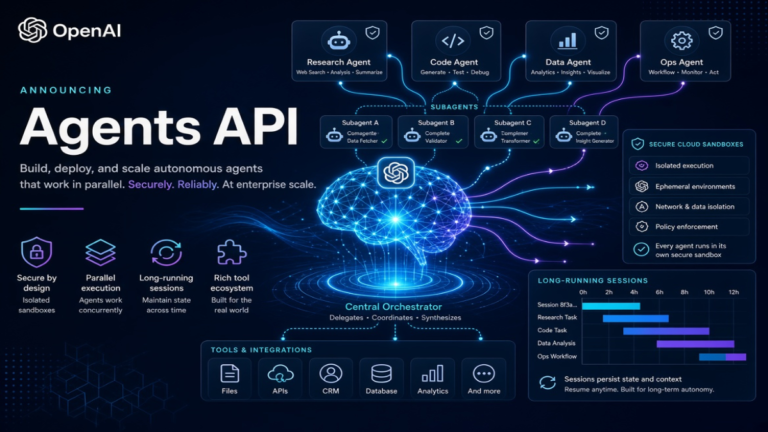
OpenAI has launched the Agents API in public beta, giving developers direct access to the managed harness and infrastructure that powers long-running Codex-style agents. The announcement, dated September 10, 2026, positions the API as a practical answer to one of the hardest problems in agentic AI: keeping a software agent reliable while it works across files, code, tools, subagents, and multi-step tasks over hours or days.
The news hook is simple but significant. Earlier AI APIs mostly returned model responses. The Agents API is designed to run work. OpenAI says its infrastructure manages context, tool use, subagent coordination, files, code execution, and persistent progress so that developers do not have to assemble every reliability layer themselves. That is a major shift in the AI stack. The core product is no longer just a model endpoint; it is an execution environment for autonomous and semi-autonomous digital workers.
What happened is that OpenAI opened a public beta around the same operational lessons it learned from scaling Codex and ChatGPT for Work. According to the company, useful agents need a strong harness that can preserve context, select and call tools efficiently, coordinate specialized subagents, and continue operating inside managed environments. The company also highlighted customer results, including an evaluation score improvement from 0.71 to 0.85 after adopting the API. That detail matters because it frames agent platforms around measurable task completion rather than vague claims about intelligence.
Why does this matter for businesses? Agentic AI projects often fail not because a model cannot write a good answer, but because the surrounding system cannot maintain state, recover from failures, enforce permissions, or explain what happened. The Agents API attacks those infrastructure gaps. For startups, it can reduce the amount of orchestration code they need to build. For enterprises, it could accelerate the move from chatbot pilots to operational workflows such as software maintenance, compliance reviews, research, customer support escalation, and internal analytics.
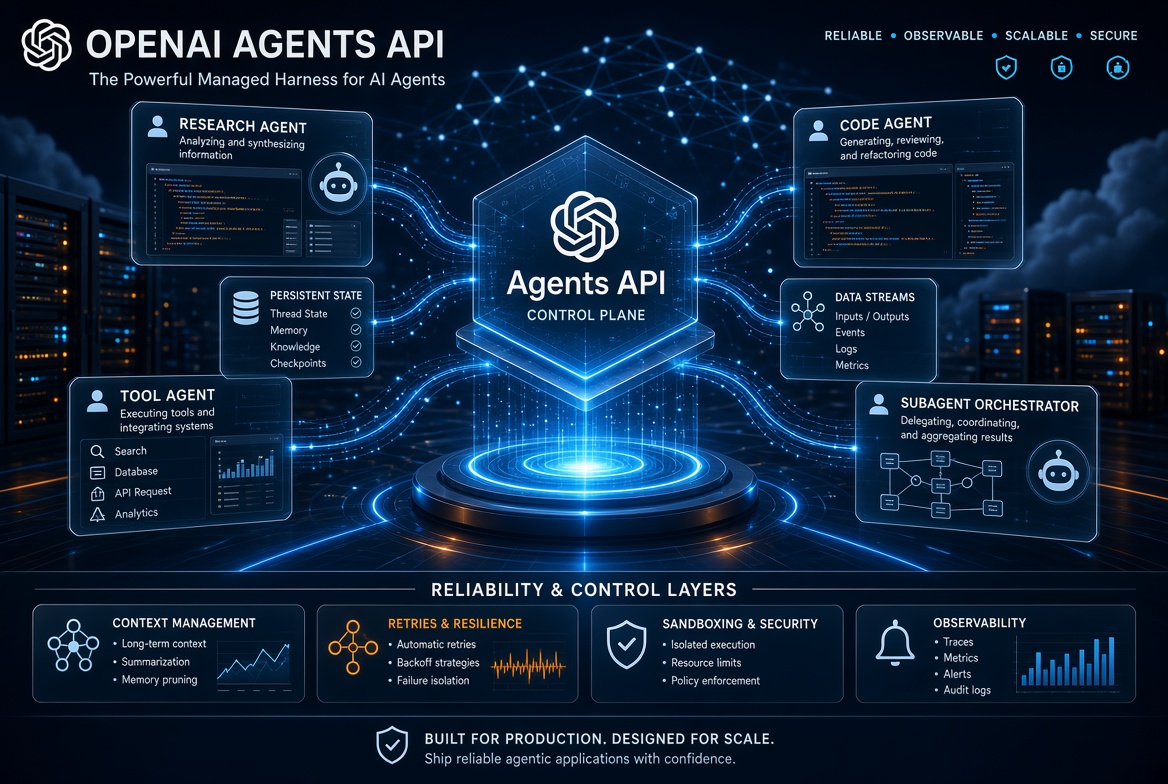
Technically, the most important idea is the harness. A harness is the control plane around the model: context management, tools, retries, state, subagents, sandboxing, files, and observability. This makes the API relevant to agentic AI architecture because model quality is only one component of production performance. The business question becomes whether the agent can complete a job with acceptable cost, latency, accuracy, and human intervention.
For Agentic Commerce, the API could support shopping and service workflows that span product discovery, catalog retrieval, inventory checks, pricing rules, fraud screening, checkout preparation, and after-sales support. An agent could compare products, call merchant systems, summarize tradeoffs, and return with a recommendation or a request for approval before purchase. In Agentic Marketing, the same infrastructure could connect campaign data, CRM records, analytics dashboards, creative generation tools, and approval policies into a continuous optimization loop.
Practical business takeaways are clear. Start with one workflow that has a measurable finish line. Define what the agent may read, change, purchase, or publish. Add approval gates for irreversible actions. Log every tool call. Track completion rate, intervention rate, error rate, cost per task, and time saved. Do not deploy a general-purpose “AI employee” before the organization has a narrow, testable operating procedure.
The future outlook is that agent platforms will increasingly compete on reliability, governance, and integration depth rather than on chat quality alone. The winners will help companies supervise many agents, evaluate them continuously, and connect them safely to real systems.
FAQ:
What is the OpenAI Agents API? It is a managed developer platform for building and running cloud agents with tools, files, code execution, context management, and subagent coordination. Is it the same as a chatbot API? No. It is designed for long-running, multi-step execution. Why is the harness important? Because production agents need memory, retries, permissions, and observability around the model. How should a business start? Choose one bounded workflow, define approvals, and measure outcomes.
Conclusion:
OpenAI’s Agents API signals that the next phase of AI adoption will be built around execution systems. The model still matters, but the real competitive advantage is the infrastructure that turns intelligence into dependable work.