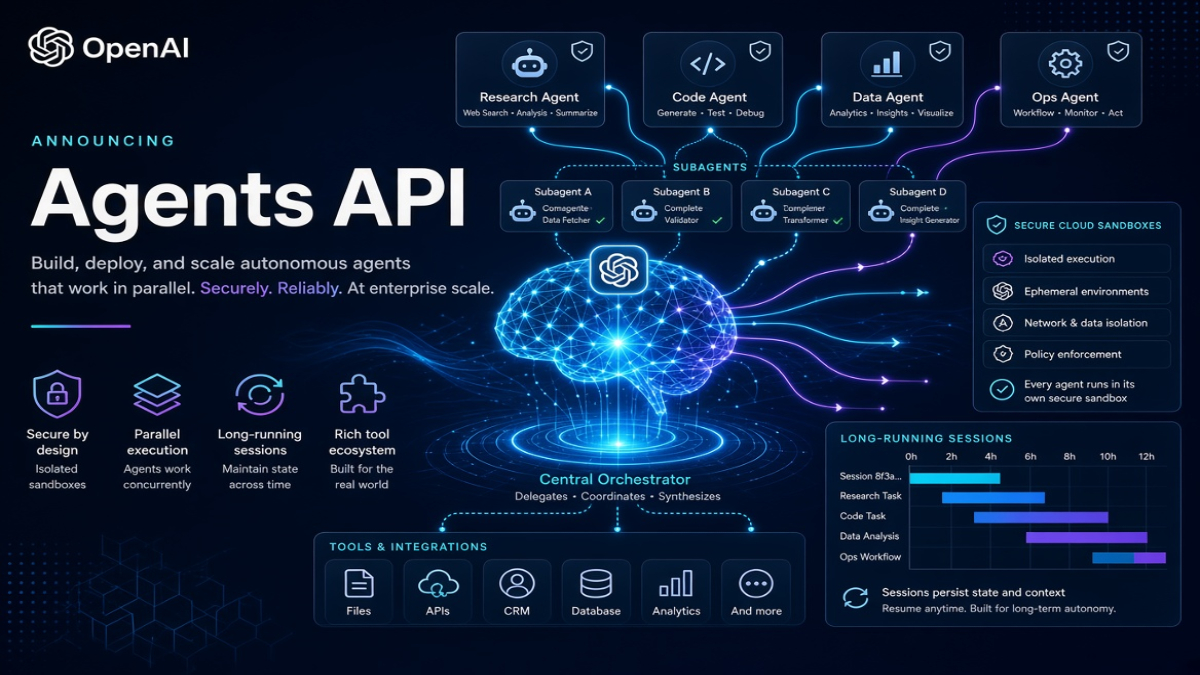
OpenAI has introduced the Agents API, a managed way to build and run cloud agents using the Codex harness. Announced on September 10, 2026, the release is designed to let developers create agents with a single API call, while OpenAI manages the execution environment, long-running sessions, tool access, and the operational plumbing required for agentic workflows. The announcement is important because it moves enterprise AI development beyond prompt-response chatbots and toward software that can plan, use tools, parallelize work with subagents, and continue operating across extended sessions.
The key news hook is simple:
OpenAI is productizing the runtime layer that turns a model into an AI worker. The Agents API includes hosted sandboxes, an evolving Codex harness, support for agents that can work across long sessions, and mechanisms that help agents efficiently use multiple tools. OpenAI also highlights subagent parallelization, which means a main agent can delegate parts of a task and combine the results. This is a meaningful architectural step because agentic systems depend on more than model intelligence. They need state, execution, tool permissions, retries, monitoring, and a controlled place to act.
Why does this matter for business?
In traditional automation, each workflow is usually hard-coded. In an agentic system, a business can describe a goal such as “research 50 qualified leads, update the CRM, draft personalized outreach, and flag high-value accounts for approval.” The model can reason about the steps, call tools, inspect the results, and continue until the objective is complete or human review is required. That changes the economics of software. The competitive advantage increasingly comes from how well a company maps its data, systems, policies, and approval rules into an agent runtime.
From a technical perspective, the Agents API points toward an orchestration model with a foundation model at the center, a sandbox for safe execution, connectors for external tools, memory or state for continuity, and observability for auditing. The Codex harness is especially relevant to software and operations teams because it suggests a standardized way to let agents inspect files, run code, test outputs, and iterate. For enterprises, the largest challenge will not be generating a useful answer. It will be controlling what the agent can access, what it can change, and how failures are detected.
The Agentic AI implications are immediate.
Developers can move from isolated copilots to multi-step systems that perform repeatable knowledge work. The Agentic Commerce implications include product catalog enrichment, customer support escalation, order-status workflows, returns triage, merchandising analysis, and supplier coordination. In Agentic Marketing, teams could deploy agents that monitor campaigns, summarize performance, generate creative briefs, coordinate content production, and update audiences across connected platforms.
Practical business takeaways: start with one bounded workflow, use least-privilege credentials, require approval before financial or customer-impacting actions, log every tool call, and measure completion rate, exception rate, human intervention, cycle time, and cost per completed task. Do not treat the agent as a magical employee. Treat it as a software system with autonomy controls.
FAQ:
What is the Agents API? It is a managed platform for building and running cloud agents. Is it only for coding? No; the same orchestration pattern can support research, operations, support, commerce, and marketing. Why use a managed runtime? It reduces the engineering burden of hosting sandboxes, session state, and tool execution. What is the biggest risk? Over-permissioned agents that can act without adequate monitoring or approval.
Conclusion:
OpenAI’s Agents API signals that the next AI platform battle will be fought at the execution layer, not only at the model layer. Companies that redesign workflows around safe, measurable agent actions will have a head start in the 2026 automation economy.