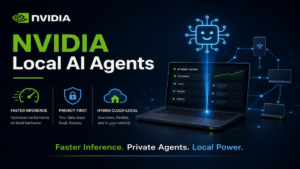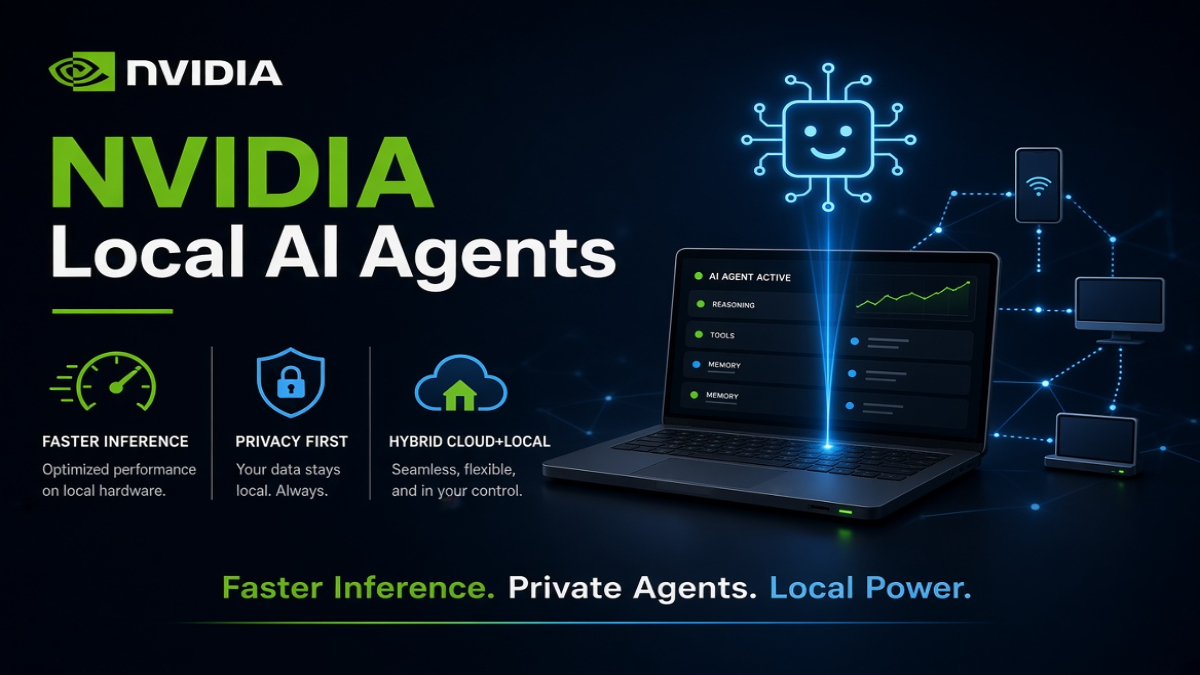
NVIDIA is pushing AI agents closer to the desktop with a new set of local-AI announcements tied to IFA 2026. The company says NVIDIA, Microsoft, and ecosystem partners are making local AI faster to run, easier to install, and more capable of supporting agents directly on consumer and developer hardware. The development matters because the future of agentic AI will not be determined only by cloud models. Increasingly, local inference can provide privacy, lower latency, offline capability, and more control over how agents interact with personal data.
One of the most notable announcements is NVIDIA PAIR, or Personal AI Router, which is designed to distribute AI inference across PCs on a user’s local network. Instead of treating every computer as an isolated AI endpoint, the concept turns multiple machines into a small local inference environment. For developers and power users, that could mean assigning workloads based on available compute rather than sending every request to a remote cloud service.
NVIDIA also says new optimizations for llama.cpp and vLLM can deliver up to 1.9 times faster local inference in the supported scenarios highlighted by the company. Faster inference matters for agents because agents do not usually make just one model call. A long-running workflow can involve planning, tool selection, retrieval, verification, summarization, and repeated reasoning. If every step is slow, the entire agent becomes frustrating. Improving inference speed can therefore improve the practical usability of autonomous systems.
The local-AI trend is especially important for agentic applications. A conventional chatbot can often tolerate a small amount of latency because a user is waiting for a single response. An agent may operate through dozens or hundreds of intermediate actions. When an agent is controlling software, processing files, observing a screen, or coordinating multiple tasks, latency accumulates. Local inference can reduce the round-trip time between the model and the environment.
Privacy is another major factor. Many organizations and individuals have data that they do not want continuously sent to external cloud services. Local agents could eventually handle private documents, personal workflows, development environments, and sensitive business operations without moving every piece of information outside the device or local network. This does not automatically make local AI secure, but it gives architects another control point.
NVIDIA’s hardware strategy also reflects the changing definition of AI infrastructure. Infrastructure used to mean data centers, GPUs, networking, and storage. Agentic AI expands that definition to include the computer on which the agent acts, the software runtime that manages tools, the model serving layer, the memory system, and the security boundaries around execution. As agents become more autonomous, compute needs are distributed across cloud and edge environments.
The implications for AI systems are substantial. A hybrid architecture may become the default: cloud models for large reasoning workloads, local models for private or latency-sensitive tasks, and routers that determine where each request should run. A personal AI router could become analogous to a network router, but for intelligence workloads. It could decide whether a task should be processed on one machine, another local device, or a remote service.
Agentic Marketing can benefit from this model as well. Marketing teams increasingly process customer data, creative assets, analytics, campaign information, and proprietary strategy. Local or hybrid agents could analyze internal information while using cloud models selectively for broader reasoning or content generation. That could create new privacy-conscious automation patterns.
Agentic Commerce also has a local component. Shopping assistants could keep preference profiles, purchase history, and personal information locally while connecting to cloud services for product discovery. Local agents might coordinate devices, manage household purchasing workflows, or interact with merchant systems without requiring every interaction to be processed centrally.
For developers, NVIDIA’s announcement reinforces the importance of open model runtimes and optimized inference. Agent builders will increasingly care not only about which model produces the best benchmark score, but also about throughput, memory requirements, latency, cost, tool integration, and deployment flexibility.
The long-term significance of NVIDIA’s local-AI push is that agents may become a distributed computing workload rather than a cloud-only feature. Personal computers could evolve into private AI execution environments, while cloud infrastructure remains essential for the largest models and workloads. The result could be a hybrid AI ecosystem in which intelligence follows the task: local when privacy and speed matter, cloud when scale and capability matter.
For businesses planning an agentic AI strategy, the practical lesson is to evaluate both cloud and local architectures. Identify which workflows require maximum model capability, which contain sensitive data, and which are latency-sensitive. Then design an infrastructure layer that can route work intelligently. The future of AI infrastructure may not be cloud versus local. It may be cloud plus local, coordinated by intelligent agents and routers.